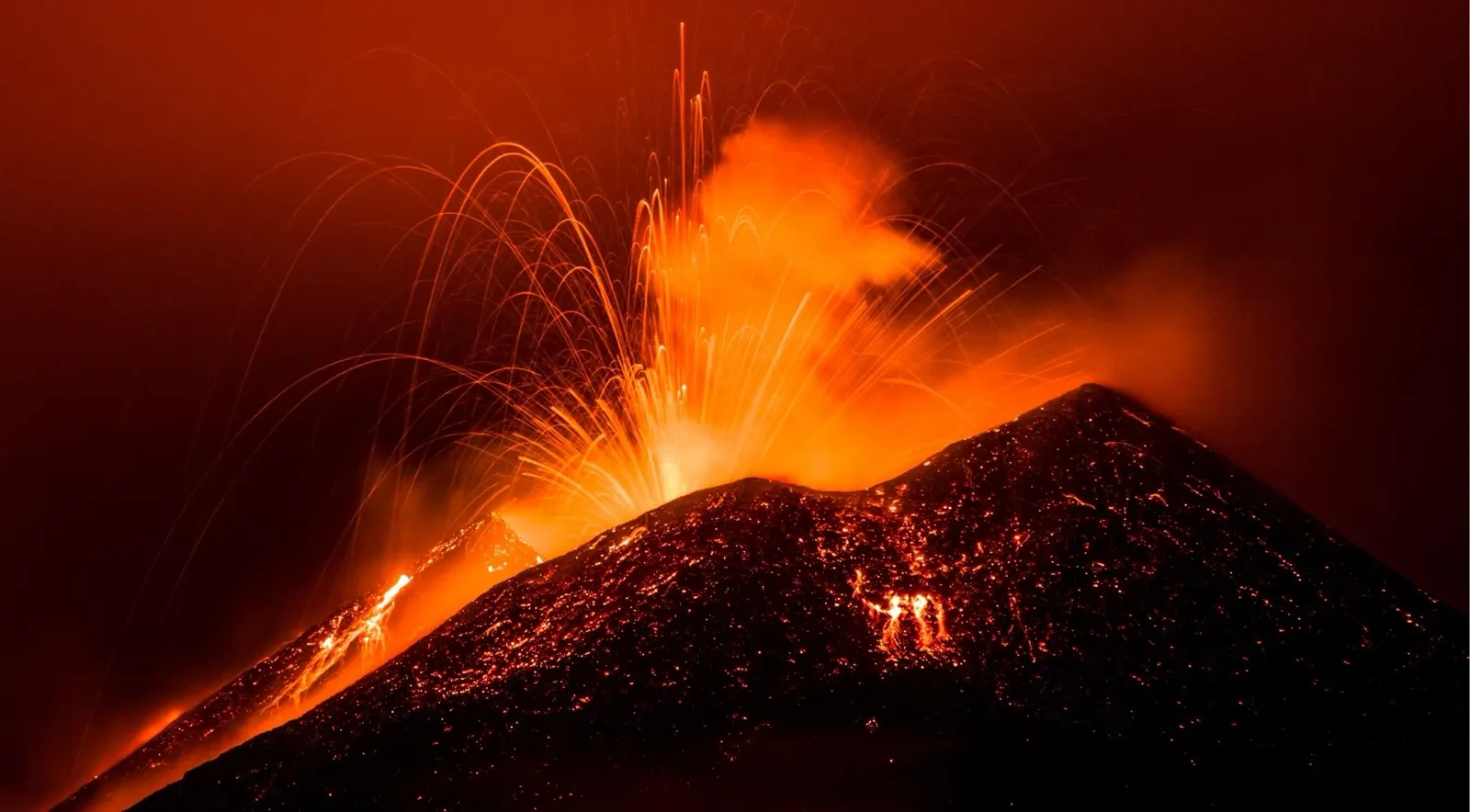
About two hundred and thirty years ago, a river of molten rock ran down Etna's south flank for 370 days, roofed itself over with a crust, then drained away. What's left is Grotta dei Tre Livelli, a 1,150-metre tunnel you can step into from a roadside lay-by with a helmet on and a headlamp lit. Etna has more than 250 caves like it. Some once stored the winter snow that chilled Sicily's first granitas, and one high on the north flank still holds ice all year. In winter, when cloud hides the craters and wind batters the ridges, a lava tube is still a good day out. Here's which caves you can reach this season, which ones the snow closes off until spring, and which tours take you inside.
The calendar above is for Kemedia's Etna Sunset Tour: Volcano trek, Cave & tasting from Catania, rated 4.8 from more than 1,800 reviews and from about $67. It's the one tour we checked that names Grotta dei Tre Livelli, Etna's longest lava tube, in its itinerary, with about 30 minutes inside, helmets and headlamps, and at most 8 people over 5 hours. In midwinter the sun sets around 17:00, so this sunset tour is in practice an afternoon outing, and you're back in Catania for dinner.
What is a lava tube, and why does Etna have so many?
A lava tube is a tunnel left behind when the surface of a lava flow cools into a hard crust while molten lava keeps flowing underneath, then drains away at the end of the eruption. Picture a river of 1,000 °C rock that built its own roof, then emptied out and left you the riverbed.
Etna is one of the best places in Europe to see one. The Centro Speleologico Etneo, the Catania caving club that has mapped Etna's caves for decades, says in a paper by Renato Bonaccorso and Roberto Maugeri for the IX International Symposium on Vulcanospeleology that "more than 250 lava caves are known, mostly are lava tubes", along with eruptive fissures and a handful of erosion caves. Other studies put it at "over 200" basaltic lava tubes. Local guides keep finding more: EtnaExcursion.it's "Etna Lava Tubes Project", founded by Dario and Paolo Teri, counts "at least 260 known caves" and reports that between 2018 and April 2023 "about 70 have been found, not considered in the general count."
What you'll see inside:
- Lava stalactites (denti di cane, "dog's teeth"): drips of re-melted rock frozen on the ceiling.
- Flow lines and benches: horizontal grooves marking the height the lava ran at.
- Lava rolls: curled sheets of crust that peeled off the walls.
- Keyhole cross-sections and stacked levels: tubes that cut down through their own floor or formed one above another, as at Grotta dei Tre Livelli.
For the volcano's current mood, see Is Etna erupting now? Scientists also study Etna's lava tubes as stand-ins for caves on Mars: a 2023 Microbial Ecology study sampled bacteria in four of them, Grotta Lunga included.
Etna's lava caves, cave by cave
The caves tours use are on the south and south-east flanks, along the SP92 road from Zafferana to Rifugio Sapienza and around Nicolosi. The north-side caves take long hikes.
Other experiences you might enjoy on Etna this winter
Add an Etna jeep tour across the lava flows of the Valle del Bove, a sunset tour at the Silvestri Craters, the Etna cable car from Rifugio Sapienza, a snowshoe walk from Piano Provenzana, or an Etna wine tasting at a winery near Zafferana Etnea or Randazzo to warm up after the cave.
| Cave | Side / nearest base | Altitude | Length | Eruption | Difficulty | Guide? | Winter access | Highlight |
|---|---|---|---|---|---|---|---|---|
| Grotta del Gatto | South-east / Zafferana Etnea (woodland trail off the SP92) | About 940 m | Small (branches of about 4 m and 29 m) | Ancient (prehistoric) lavas | An easy walk in | Recommended | The lowest cave on the tour circuit, rarely snowbound | Mossy oak woods; a gentle first cave for kids |
| Grotta Cassone | South / Piano del Vescovo, Zafferana (beside the SP92) | About 1,400 m | About 250–300 m (sources differ) | 1792 (found in 1964 during road building) | Easy; standing height most of the way | Yes | Usually reachable, but a partial collapse of the entrance section was reported in 2018, so ask your operator which part they use | A big, walkable tube with rope lava on the floor |
| Grotta dei Tre Livelli | South / Casa del Vescovo, about 5 km below Rifugio Sapienza (beside the road) | About 1,625–1,675 m | 1,150 m (Etna's longest lava tube), with a 304 m vertical drop | 1792–93 (a 370-day eruption) | Tours use the first section; the deeper levels need a ladder or rope (a 6 m step) | Yes | Usually reachable; the entrance can be icy | Three stacked galleries; also called the Galleria dei Pipistrelli (bat gallery) |
| Grotta Lunga (Monpeloso) | South / Nicolosi | About 850 m | About 55 m | 252–253 AD | Easy, short | Recommended | Low and reliable | A pointed "Gothic arch" roof |
| Grotta dei Ladri / Ladroni ("della Neve") | East / Mareneve road km 19, Sant'Alfio | About 1,550 m | About 59 m | Prehistoric | Easy | Recommended | Depends on snow and on whether the Mareneve road is open | A historic snow store with carved steps and "1776" cut at the entrance |
| Grotta di Serracozzo | East / Milo | About 1,840 m | About 350 m, with a 60 m drop | 1971 | Moderate; low, tight sections | Yes | Often snowbound in midwinter | A tube starting from an eruptive fissure |
| Grotta dei Lamponi | North / Passo dei Dammusi (Linguaglossa–Castiglione area) | About 1,750 m (Park); 1,720 m according to Guide Vulcanologiche Etna | 400 m (Park) to about 700 m (other sources) | 1614–24 | Walk-in, but a long approach (12–16 km round trip) | Yes, in practice | The approach is usually snowbound from December to March | Huge pahoehoe lava fields; one of Etna's longest tubes |
| Grotta del Gelo (ice cave) | North-west / Sciara del Follone, Randazzo | About 2,030–2,043 m | About 120–125 m | 1614–24 | Hard: a 7–11 hour trek; crampons inside | Yes | Not a winter trip | Perennial ice, described as Europe's southernmost glacier |
| Grotta delle Palombe (Nicolosi / Monti Rossi) | South / Nicolosi | About 830–980 m | A fracture cave about 120 m deep | 1669 | Technical (vertical shafts) | Speleologists only | n/a | First descended by Mario Gemmellaro in 1823 |
Altitudes and lengths come from the Centro Speleologico Etneo's cadastral files, the Parco dell'Etna's UNESCO site and local trail databases; where sources disagree we show a range or name each source. Grotta Cassone: Etnatracking posted on 22 August 2018 that "il tratto iniziale della grotta è crollato" (the initial stretch has collapsed) and that entry was not allowed at the time. Operators' 2026 GetYourGuide itineraries still list Cassone as an optional stop, and a 2025 CAI Belpasso excursion sheet routes walkers to its entrance from the SP92, so we couldn't confirm the current state of the cave. Ask before you book.
A note on names: "Grotta delle Palombe" is used for at least two different caves, the deep 1669 fracture cave at Monti Rossi near Nicolosi and a lava tube at about 1,570 m on Park trail 720. "Grotta Lunga" is used loosely too: one guide site describes a different Grotta Lunga in 1792 lava, with bats. If a tour names a cave, ask which one.
Are Etna's lava caves open in winter?
Yes. No authority closes the caves for winter. Snow, ice and road access can keep you out, and your guide makes the call on the day. The caves are natural features in the Parco dell'Etna, not ticketed attractions, so there are no opening hours.
| Cave type | Examples | December–February | Who decides on the day |
|---|---|---|---|
| Low woodland caves (about 850–1,000 m) | Grotta del Gatto, Grotta Lunga | Almost always accessible; muddy or wet underfoot | Your guide |
| Roadside south-side tubes (about 1,400–1,700 m) | Cassone, Tre Livelli | Usually accessible once the SP92 is cleared; icy entrance slopes after cold nights | The guide, plus road status (snowplows, chains rules) |
| East and north caves off the Mareneve road and the Pista Altomontana | Ladroni, Serracozzo, Lamponi | Often snowbound; access depends on road ordinances | The guide, plus municipal and Città Metropolitana road orders |
| High remote caves (2,000 m and up) | Grotta del Gelo, Grotta del Lago | The entrance is "often hidden by the snow"; not offered | Guides don't schedule it in winter |
| Summit-zone access (not caves) | n/a | Governed by the volcanic alert level and summit ordinances | The Prefettura, municipalities, INGV and Civil Protection |
Month by month
| Month | What to expect at the caves | Read next |
|---|---|---|
| November | Usually the last good month for the north-side caves; the first snow is possible above 1,800 m | Etna in November |
| December | The south-side roadside caves are fine; Lamponi and Gelo are off the table after the first big snowfall | Etna in December |
| January | The coldest month, with icy entrances at Tre Livelli and Cassone; caves make a good bad-weather Plan B | Etna in January |
| February | Much like January; snowshoe tours that include a cave stop are at their best | Etna in February |
| March | The snow retreats; the north-side caves start opening up to hikers later in spring | How high can you go on Etna in winter? |
What about the volcano? Italy's Civil Protection Department has had Etna at yellow alert since 26 June 2026, and INGV's weekly bulletin of 6 October 2026 reported variable degassing, weak and discontinuous ash emissions from the North-East Crater, and low volcanic tremor. Alert levels and summit restrictions apply to the summit zone, and the tour caves sit 1,300–2,000 m lower, so summit closures rarely affect a cave visit. Eruptions can still close roads, though: in August 2026, ordinances shut parts of the Mareneve road on the east and north sides for several days during a flank eruption. Check Is Etna erupting now? before you go.
Why caves make a smart winter Plan B: when cloud, wind or fresh snow spoil the views higher up, a lava tube still delivers. It's sheltered from the wind, it doesn't depend on visibility, and inside it feels cool but steady. Several operators swap in a cave stop when summit plans fall through.
Can you visit Etna's lava caves without a guide?
Legally, only some caves. In practice, we don't recommend it in winter. The Parco dell'Etna's visitor regulation (Regolamento per le attività di fruizione del Parco, adopted by Council Resolution no. 21 of 30 October 2003, as reproduced on etnalife.it and etnino.it) splits caves into groups:
- Caves "that do not present particular risks" will get Park signage and "may be used freely" (potranno essere fruite liberamente).
- Caves "that present risks to people" may be visited only "with qualified escorts belonging to speleological associations", and the purpose of the trip must be communicated to the Park in advance.
- Visits are not allowed in caves "where animal communities are present or biological or microclimatic conditions that could be damaged".
We couldn't fetch the Park's original PDF, and the Park has a later plan action to regulate cave entry ("Regolamentazione Ingresso Grotte") whose status we couldn't confirm. In practice, small woodland caves like Grotta del Gatto sit on public nature trails, and the Regione Siciliana's VisitSicily site describes the Gatto trail as walkable in all seasons. Bigger or deeper caves are another matter: Tre Livelli has a 6 m drop between levels, and the Palombe fracture cave has vertical shafts down to about 120 m. That's speleology, not sightseeing.
| Self-guided | Guided tour | |
|---|---|---|
| Which caves | Only small, signposted, low-risk ones | The tour caves, plus some deeper sections with speleo guides |
| Gear | Bring your own helmet and two light sources | A helmet and a headlamp or torch are included on GetYourGuide tours |
| Winter risk | Icy entrance slopes, early dark (sunset around 17:00), no phone signal underground | The guide knows the conditions and turns back if needed |
| Interpretation | None | The guide explains the eruption that made the tube |
| Cost | Free | From about $66–68 for a half-day tour on GetYourGuide; about €65 for a dedicated caving trip |
| Our verdict | Only for experienced hikers, at Grotta del Gatto, in daylight | Recommended for almost everyone |
Why we recommend a guide:
- Rockfall and loose blocks. Lava-tube roofs collapse. The CSE files record breakdowns in almost every major cave, and Cassone's entrance section reportedly collapsed in 2018.
- Falls at entrances. Many caves are entered through roof collapses or skylights, and one local site reports a fatal fall by a visitor into the Tre Livelli entrance area.
- Cold and darkness. Phone torches fail, and the cold drains batteries fast.
- Wildlife. Tre Livelli's other name is the Galleria dei Pipistrelli (bat gallery), and guides note bats in other south-side tubes. Disturbing hibernating bats in winter can kill them.
- Finding the right cave. Several share names, and some are unmarked.
Which Etna tours include a lava cave?
Most cave visits come as a 20–40 minute stop inside a half-day tour, not as a dedicated caving trip. These are the GetYourGuide tours whose listings include a lava cave with gear. Prices are "from" figures in USD at our last check; ratings are GetYourGuide's, rounded to one decimal, with review counts rounded down. The tour formats themselves (jeep vs van, morning vs sunset) are compared in Etna jeep tours in winter and Etna sunset tours in winter.
| Tour (GetYourGuide name) | Operator | From | Cave in the itinerary | Rating | Duration / group | Best for |
|---|---|---|---|---|---|---|
| Catania: Etna Sunset Tour, Lava Cave by Jeep & Van | Etna & Sea Excursions | Catania, about $68 | Grotta del Gatto and/or Grotta Cassone (optional stops); helmet and flashlight | 4.7 (2,700+) | 5–5.5 h, max 8 | The most-reviewed classic |
| Catania: Etna Morning Tour, Lava Cave by Jeep & Van | Etna & Sea Excursions | Catania, about $67 | Grotta Cassone / Grotta del Gatto | 4.7 (900+) | About 5 h | The morning version; better on short winter days |
| Catania: Mount Etna Sunset Tour with 4x4 Vehicles | Red Etna | Catania, about $68 | "An impressive volcanic cave"; helmet and flashlight | 4.9 (850+) | 5.5 h | The top-rated sunset-and-cave tour |
| Etna Sunset Tour: Volcano trek, Cave & tasting from Catania | Kemedia | Catania, about $67 | Grotta dei Tre Livelli (30 min); helmet and headlamp | 4.8 (1,800+) | 5 h, max 8 | The best cave on the circuit |
| From Catania: trek on Mount Etna, Lava Cave & tasting Tour | Kemedia | Catania; see the live price | Grotta Lunga (optional); helmet and lamp | 4.8 (700+) | About 7 h, max 8 | Daytime, with more walking |
| Catania: Mount Etna Morning/Sunset Tour (Pick Up & Tasting) | Certified by GetYourGuide | Catania, about $66 | "Lava flow cave"; helmet and flashlight | 4.8 (4,400+) | 6 h; highest point 2,100 m | The bestseller, with a choice of times |
| Catania: Etna Morning or Sunset Trek with Lava Tunnel & Gear | Etna periperi Excursion | Catania; see the live price | The Grotta Lunga area; helmet and flashlight | 5.0 (30+) | About 5–6 h | Hikers; a smaller review base |
| Taormina: Mount Etna Sunset Tour with Cave Visit and Tasting | Kemedia | Taormina, about $88 | Grotta dei Tre Livelli (listed); helmets and headlamps | 4.7 (490+) | 5 h, small group | The best from Taormina |
| Etna 4x4 Jeep Tour from Catania and Taormina: Lava Cave, Lunch and Alcantara | etnalivetour | Catania, Taormina or Linguaglossa, about $130 | A lava cave with helmet and headlamp (not named) | 4.8 (40+) | 4.5–8 h | A full day with the Alcantara Gorge (viewpoints only in winter) |
| Mount Etna: Guided Snowshoeing Trekking Tour | Empeeria | Taormina area; see the live price | "Tour of a volcanic cave" included | 5.0 (1 review) | 4 h; minimum height 1.50 m | Snow and a cave in one outing; only one review so far |
Some tours don't name their cave, and guides choose on the day based on conditions. More cave listings are on GetYourGuide's Etna volcano tours page.
Booking direct (not on GetYourGuide):
- Dedicated caving in Grotta dei Tre Livelli: Sicilia Adventure, listed on Manawa from €65 for 5 hours, ages 10 and up, helmet provided, with "at least five" levels explored.
- Grotta del Gelo treks (spring to autumn): Guide Vulcanologiche Etna Nord (€50, on request, minimum 6, suggested for May–June and October–November); Aitne Med (€55, 7–9 hours from Piano Provenzana); EtnaLava (Grotta del Lago and Gelo, €75, May–September); Etnatracking (21 km from Zafferana, €50). Prices are 2025–26 listings.
- Grotta dei Lamponi trek: Guide Vulcanologiche Etna Nord from Piano Provenzana (12 km, 6–7 hours, difficulty E).
- Taormina with Grotta dei Ladroni and a winery: Sicily Active's "Mount Etna Wine Tour" (max 8 guests). For winter winery days, see Etna wine tasting in winter.
Coming without a car? See Etna without a car in winter.
Our picks: the best Etna lava cave tours this winter
- Best overall: Kemedia's Etna Sunset Tour: Volcano trek, Cave & tasting from Catania. It names Grotta dei Tre Livelli in the itinerary, caps groups at 8 and hands out headlamps.
- Highest rated: Red Etna's Catania: Mount Etna Sunset Tour with 4x4 Vehicles, at 4.9, has the best reviews of any cave tour we checked. Its listing doesn't name the cave, so ask which one.
- The safest bet, with the most reviews: Catania: Etna Sunset Tour, Lava Cave by Jeep & Van, with more than 2,700. Grotta del Gatto and Cassone are low enough to stay reachable after snow.
- For kids: look for a Grotta del Gatto or Grotta Lunga stop, which are short, low and walk-in, and book the morning version, Catania: Etna Morning Tour, Lava Cave by Jeep & Van, so you're not underground at dusk. Family days on the mountain are planned out in Etna with kids in winter.
- Real caving: the Sicilia Adventure trip in Tre Livelli (booked direct, from €65, ages 10 and up). Between spring and autumn, add a guided Grotta del Gelo trek.
- From Taormina: Kemedia's Taormina: Mount Etna Sunset Tour with Cave Visit and Tasting (4.7). More Taormina options are in Etna tours from Taormina in winter.
- Snow and a cave together: Empeeria's Mount Etna: Guided Snowshoeing Trekking Tour includes a cave visit, but has only one review so far. See snowshoeing on Mount Etna.
Skip a cave-focused tour if you're claustrophobic (pick a sunset or jeep tour where the cave stop is optional), if you have significant mobility limits (entrances are uneven rubble slopes), or if you specifically want the ice cave in winter, which isn't offered.
Grotta del Gelo: Etna's ice cave, and why it isn't a winter trip
Grotta del Gelo is a lava tube at about 2,030–2,043 m on Etna's north-west flank, in the Sciara del Follone lava field of the 1614–24 eruption. It holds perennial ice and is often called the southernmost glacier in Europe. It's about 120–125 m long, and the average temperature at the back of the cave is about −0.6 °C. A May 2016 laser-scanning expedition, run with speleologists of the Centro Speleologico Etneo and supported by INGV (Palermo section) and the Park, described "a persistent stack of ice with a volume of about 1.500 cubic metres". A conference abstract by Santagata et al. gives a much lower 350–400 m³, so treat any ice-volume figure as approximate.
- Getting there: there's no road. The Park's trail 726 runs 3.35 km with 325 m of climb from Grotta dei Lamponi. The full day takes 7–9 hours with operators starting at Piano Provenzana, or it's about 21 km on foot from the Zafferana side.
- Inside: an ice floor, ice stalactites and stalagmites, and steep icy sections. Guides supply crampons and helmets.
- Season: guides run it from late spring to autumn. Guide Vulcanologiche Etna Nord suggests "May–June and October–November", EtnaLava runs it from May to September, and Etnatracking recommends spring to early summer. In winter its entrance is often hidden under snow.
- Fragile: the Park's volcanologist Salvatore Caffo has linked the remaining ice to the changing Mediterranean climate and noted that snow builds up there less often. Geologist Domenico Ravidà, writing for Geopop in March 2023, reports that measurements between 2013 and 2018 showed seasonal variation and a fall in ice volume of roughly 6 m³ a year. Don't touch or break the ice formations.
The winter alternative: visit Tre Livelli or Cassone now, and save Gelo for a trip in May or October.
The snow-trade caves: how Etna's lava tubes chilled Sicily's granita
Before refrigerators, Etna's lava caves worked as natural freezers. Each winter, snow gatherers packed snow into caves and pits called neviere, then sold it in summer to cool drinks and sorbets, the ancestor of Sicilian granita.
- Grotta dei Ladri / Ladroni (Mareneve road, Sant'Alfio) is the textbook example. CSE speleologists found it had been modified with three wells dug to fill it with snow. A date, "1776", is carved at the entrance, and the French artist Jean Houël painted it as Grotte à la neige in 1784.
- Grotta degli Archi (Biancavilla) "was probably used as a snow deposit" about a century ago, according to the CSE.
- The Malta connection: Maltese sources say the Knights of Malta bought Etna snow, shipped it on a fast boat called the Tartana della Neve, and appointed a contractor (Salvatore Vella in 1770) to keep Valletta supplied. It's secondary history, so read it as a story rather than a citation.
So when you eat a granita in Catania after your tour, you're tasting the reason people first went into these caves.
Safety and what to wear in an Etna lava cave
Are Etna lava caves safe? On a guided tour with a helmet and a light, the short tour caves are low-risk for anyone who can walk on uneven ground. Watch your footing on rough lava, mind your head under low ceilings, and take care on icy entrance slopes in winter.
| Item | Provided on tours? | Why it matters in winter |
|---|---|---|
| Helmet | Yes | Ceilings drop low, and the lava "teeth" are sharp |
| Headlamp or torch | Yes (some tours give a handheld torch) | Bring a backup; the cold drains batteries |
| Sturdy boots with grip | Bring your own (some operators rent them) | Entrances are loose rubble, with frost and ice after cold nights |
| Gloves | Bring | Lava is abrasive, and gloves keep your hands warm on cold rock |
| Layers and a windproof jacket | Bring | Cold wind outside at 1,600–2,000 m; cool and damp inside |
| Long pants | Bring | They protect your knees on low sections |
| A small bag, hands free | — | You'll want your hands for balance |
The full kit list is in what to wear on Etna in winter.
Who should think twice:
- Claustrophobia: tour caves are mostly walk-in with standing room, but parts can be low or narrow. Tell your guide; you can usually wait outside.
- Mobility: entrances often mean scrambling down a slope of collapsed blocks, and they aren't wheelchair-accessible.
- Kids: short caves like Gatto, Lunga or the first part of Cassone suit school-age children, and family reviewers mention kids aged 8 and 9 on cave tours. The dedicated Tre Livelli caving trip is listed for ages 10 and up. See also Etna with kids in winter.
A lava-tube explainer for kids (read it aloud in the van): "Imagine squeezing toothpaste. The outside dries into a skin while the soft paste keeps moving inside. When it all squirts out, you're left with an empty tube. Etna did that with lava, and now we can walk through the tube."
Driving yourself? From 15 November to 15 April you need winter tires or chains on board on Etna's provincial roads, according to the Città Metropolitana di Catania, and Guide Vulcanologiche Etna Nord gives the same dates for the north side. See driving to Etna in winter.
Photography inside lava caves
- Phone: use Night mode, brace against the wall or your helmet, and hold still for the full exposure. Turn the flash off: it flattens texture and lights up dust.
- Light painting: ask someone in your group to sweep a headlamp across the walls during a 2–3 second exposure to bring out the flow lines and lava stalactites.
- Headlamp settings: use a warm or low setting for photos, because a cold-white beam looks harsh on black basalt. Never shine a beam on roosting bats.
- The best shot: the skylight or entrance from inside, looking out at daylight or snow.
- Camera: a wide lens (16–24 mm), ISO 3200–6400 and f/2.8. A small tripod is fine if the group isn't waiting on you.
Conservation: bats, fragile minerals and Park rules
- Bats: caves with "animal communities" are off-limits under Park rules. Keep your voice low, don't touch walls where bats roost, and never shine lights on them.
- Minerals: the CSE recorded rare secondary minerals in young caves such as Grotta Cutrona (in 1991–93 lava) that rainwater and changing temperatures later destroyed. Fragile features don't grow back.
- Leave no trace: don't take lava "souvenirs", and don't leave graffiti or candles.
FAQ: Etna lava caves in winter
Are Etna's lava caves open in winter?
Yes. Caves have no opening hours or seasonal closure. The low and mid-altitude caves on the south side (Grotta del Gatto, Grotta Cassone, Grotta dei Tre Livelli and Grotta Lunga) are visited on guided tours all winter. High caves such as Grotta del Gelo are snowbound and not offered until late spring.
What is the best Etna lava cave tour?
For the cave itself, Kemedia's Etna Sunset Tour: Volcano trek, Cave & tasting from Catania stands out because it names Grotta dei Tre Livelli, Etna's longest lava tube. For ratings, Red Etna's 4x4 sunset tour scores 4.9. For the most reviews, Etna & Sea Excursions' jeep and van sunset tour has more than 2,700.
Can you visit lava caves on Etna without a guide?
Only low-risk, signposted caves may be visited freely under Parco dell'Etna rules. Risky caves require qualified speleological escorts and prior notice to the Park, and caves with sensitive wildlife are closed to visitors. In winter we recommend a guide for every cave.
Can I visit Grotta del Gelo in winter?
Not realistically. The ice cave sits at about 2,040 m, its entrance is often buried by snow in winter, and guides run it from late spring to autumn. It's a 7–9 hour trek, and you need crampons inside.
Where is Grotta dei Tre Livelli?
On the south flank at Casa del Vescovo (Zafferana Etnea), right beside the SP92 road, about 5 km below Rifugio Sapienza. It's 1,150 m long with a 304 m drop and formed in the 1792–93 eruption. Tours visit the upper section.
Is Grotta del Gatto worth it?
It's a small cave at about 940 m on a woodland nature trail above Zafferana. It's short and gentle, and good for children and wet days, but don't expect big chambers. Tours often pair it with Grotta Cassone.
Are Etna lava caves safe?
On a guided tour with a helmet and lamp, the short tour caves are low-risk for people who can walk on uneven ground. The hazards are trips, low ceilings, loose rock and icy entrance slopes in winter. Deeper caves with vertical drops are for speleologists only.
What should I wear in a lava cave on Etna?
Sturdy hiking boots with good grip, long pants, gloves and warm windproof layers. Tours provide a helmet and a headlamp or torch. In winter, bring a hat and a spare light, because the cold drains batteries.
Are Etna lava caves suitable for kids?
Yes. Short walk-in caves such as Grotta del Gatto and Grotta Lunga suit school-age children, and family reviewers mention kids aged 8–9 on cave tours. Dedicated caving trips in Tre Livelli are listed for ages 10 and up. Choose a morning tour in winter.
Do Etna cave tours run from Taormina?
Yes. Kemedia's Taormina: Mount Etna Sunset Tour with Cave Visit and Tasting (4.7) includes a lava cave with helmets and headlamps. Snowshoe and 4x4 tours from the Taormina side also include cave stops.
How long is the cave part of a tour?
Usually 20–40 minutes inside a 5–7 hour tour. Kemedia lists 30 minutes at Grotta dei Tre Livelli, and Etna & Sea Excursions lists 30-minute optional stops at Grotta del Gatto and Grotta Cassone.
How many lava caves are there on Etna?
The Centro Speleologico Etneo counts more than 250 known lava caves, mostly lava tubes. The EtnaExcursion.it team reports finding about 70 more unpublished caves between 2018 and April 2023, so the real number is higher.
Does volcanic activity close the caves?
Rarely, directly. Alert levels mostly restrict the summit area, far above the tour caves. Eruptions can close access roads, as in August 2026 on parts of the Mareneve road. Check INGV and Civil Protection updates before you go.
What were Etna's snow caves used for?
Some caves, such as Grotta dei Ladri on the Mareneve road, were turned into neviere: snow was packed in during winter and sold in summer to chill drinks and sorbets, the ancestor of Sicilian granita.
Official sources to check before you go
- Ente Parco dell'Etna (cave rules and access ordinances): parcoetna.it
- Parco dell'Etna UNESCO site (cave and trail pages): unescoparcoetna.it
- INGV Osservatorio Etneo (weekly volcanic bulletins): ct.ingv.it
- Dipartimento della Protezione Civile (the national alert level): rischi.protezionecivile.gov.it
- Città Metropolitana di Catania (winter road rules and road ordinances): cittametropolitana.ct.it
Sources for this page: Centro Speleologico Etneo cadastral files and symposium papers, the Mungibeddu cave cadastre, the Parco dell'Etna and its UNESCO site, the Park's 2003 visitor regulation (as reproduced on etnalife.it and etnino.it), INGV, the Dipartimento della Protezione Civile, VisitSicily (Regione Siciliana), the 2016 Grotta del Gelo laser-scan expedition, Springer's Microbial Ecology and MDPI's Land, Geopop, EtnaExcursion.it, Etnatracking, Guide Vulcanologiche Etna Nord, Aitne Med, EtnaLava, Manawa, CAI Belpasso, GetYourGuide listings, and reports in EtnaLife, CataniaToday, MaltaDaily and EtnaWay.
Final Word
A lava cave is one of the few things on Etna that winter barely touches. The roadside tubes above Zafferana and Nicolosi stay reachable on most days, a guide brings the helmet and the light, and 30 minutes underground is a fine answer to a morning when the craters are lost in cloud. Book a tour that names its cave if the cave is why you're going, choose a morning departure with children, and keep Grotta del Gelo for a May or October trip.
Related reading: Etna jeep tours in winter · Etna sunset tours in winter · Etna wine tasting in winter · Mount Etna in winter: what's open