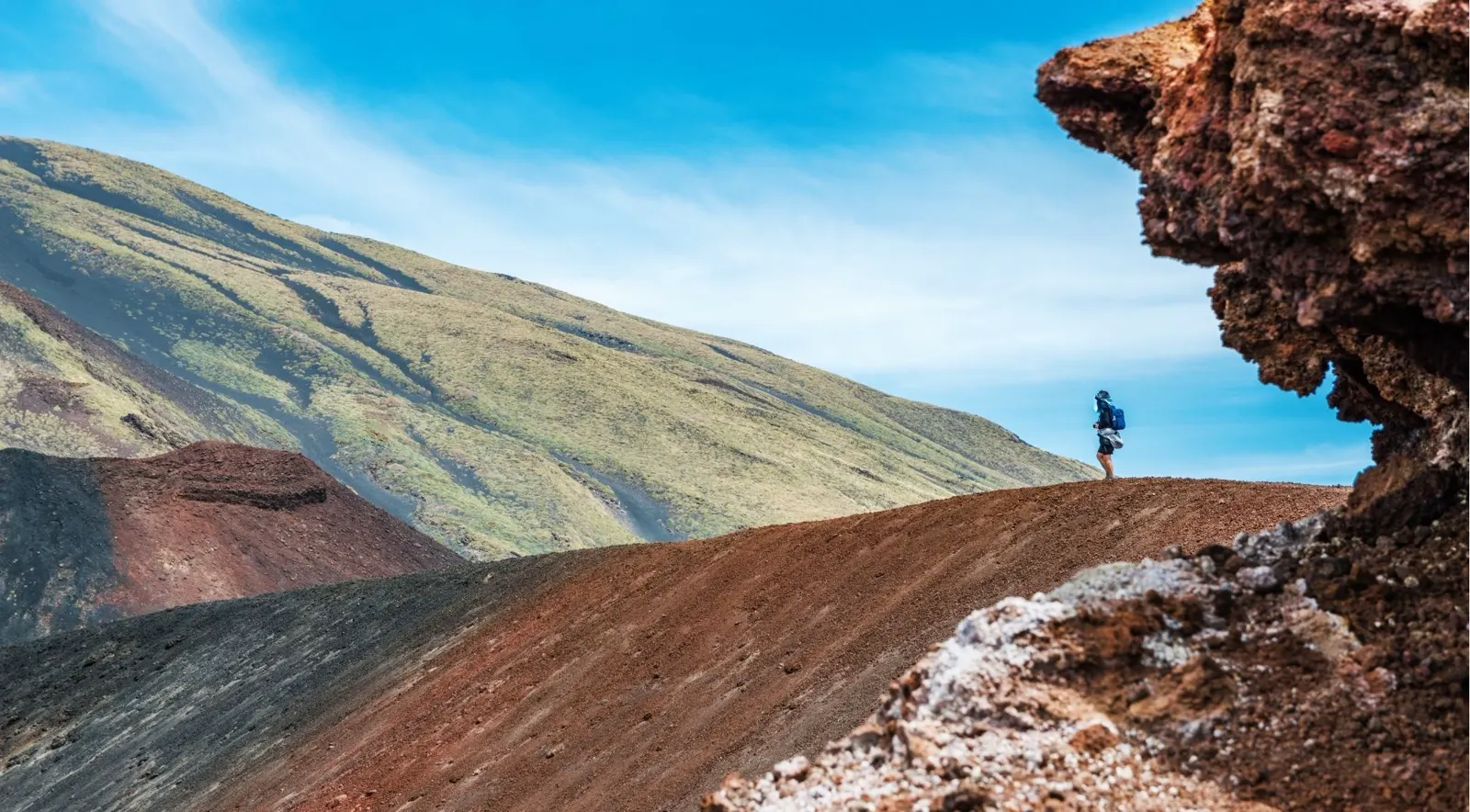
You can eat breakfast in a T-shirt on a Catania terrace and stand in a −15 °C wind chill near the craters before lunch. Europe's highest active volcano rises to 3,403 m (INGV's September 2024 measurement of the Voragine crater rim; the height changes with eruptions) above a coast that rarely sees frost, so the clothes that suit the rest of your Sicily trip won't suit the mountain. Up there the sun burns harder off the snow, the black volcanic sand ruins trainers, and the wind can make it feel far colder than the thermometer says. This guide covers how cold it gets at each altitude, how to layer, when you need proper boots, what you can rent at the cable car, and which tours include the gear.
If you'd rather not pack winter gear at all, the calendar above is for the Mount Etna: Trek to 3000m with cable car and 4x4, from $62 and rated 4.6/5 from more than 4,800 reviews on GetYourGuide. The guides lend ankle trekking boots, long thick socks, a helmet, a K-way jacket, a backpack and trekking poles (in limited numbers), so you only need warm layers, a hat and gloves of your own. The cable car and 4x4 bus cost €45 per person on site, in cash, and lunch and water aren't included.
How cold is Etna in winter?
Much colder than anywhere else on your Sicily trip. In January, Catania averages a 15.8 °C high and a 4.8 °C low (1991–2020 normals). Around Rifugio Sapienza, at about 1,900 m, 3BMeteo's 15-year averages for early January show a high of about 4 °C and a low of about 0 °C. Every 1,000 m you climb takes off roughly another 5–6.5 °C, so the 2,500 m cable-car top and the tour area at 2,900–3,000 m are usually below freezing all day in mid-winter, before you add the wind.
Etna weather by altitude on a typical January day
| Altitude and place | What's there | Typical January high / low | What it feels like | Snow on the ground? |
|---|---|---|---|---|
| Coast, 0–50 m (Catania, the Taormina area) | Your hotel, the port, the airport | 15.8 °C / 4.8 °C (Catania) | Spring-jacket weather | No |
| About 700 m (Nicolosi at 698 m, Zafferana, Linguaglossa) | The last towns, wineries, Etna Park gateways | January mean 6.5 °C (Nicolosi, 1961–90); cold mornings can be near 1 °C | Damp, chilly, sometimes foggy | Occasionally, in cold snaps |
| About 1,800–1,900 m (Piano Provenzana, Rifugio Sapienza) | Car parks, the Silvestri craters, ski lifts, the cable-car base | About 4 °C / about 0 to −1 °C (3BMeteo 15-year average); mean about 2 °C | Freezing in shade or wind; pleasant in still sun | Usually, December to March |
| About 2,500 m (cable-car top station) | A bar, rentals, the walk to the 2001 and 2002 craters | An estimated 0 to −3 °C by day, −5 °C or lower at night* | Exposed, often very windy | Almost always in mid-winter |
| About 2,900–3,000 m (the former Torre del Filosofo and Barbagallo craters; about 2,800–2,850 m on the north side) | Where the Tour 3000 and guided treks turn around | An estimated −3 to −8 °C* | −15 to −22 °C in strong wind | Yes, plus ice |
| Summit craters, about 3,300 m and higher | Only with authorized guides, when the ordinances allow | January mean about −6 °C (a tourism-site estimate for 3,400 m) | Brutal in the wind, with volcanic gas | Yes |
*Estimates interpolated with a standard lapse rate of about 5–6.5 °C per 1,000 m. Etna has no published official climate normals for these altitudes, so treat them as a guide, not a forecast.
Extremes do happen. In the January 2017 cold wave, etnasci.it's private weather station at Piano Provenzana recorded a maximum of −10 °C, a minimum of −12 °C and gusts of 72 km/h.
Other experiences you might enjoy on Etna this winter
Ride the Etna cable car from Rifugio Sapienza to 2,500 m, join a guided trek toward the summit craters or above the Valle del Bove, go snowshoeing or skiing at Piano Provenzana, or book an Etna sunset tour by 4x4 jeep with a lava cave and pickup in Catania or Taormina, then warm up with Etna wine tasting on the lower slopes.
Wind chill: the number that matters most
On Etna, the thermometer reading isn't what you feel; the wind is what makes it bite. Using the standard wind-chill formula (the one Environment Canada and the US National Weather Service use):
| Air temperature | Wind 20 km/h | Wind 30 km/h | Wind 50 km/h |
|---|---|---|---|
| +2 °C | −3 °C | −4 °C | −5 °C |
| 0 °C | −5 °C | −6 °C | −8 °C |
| −5 °C | −12 °C | −13 °C | −15 °C |
| −10 °C | −18 °C | −20 °C | −22 °C |
Our take: if the forecast shows anything below 0 °C at 2,500 m and wind above 30 km/h, dress as if it were −15 °C. Bring a hood and cover every bit of skin.
How fast does the weather change?
Very fast. A clear morning in Catania can mean cloud on the summit by noon. A band of fog often sits around 1,200–2,000 m, so you may drive up through grey drizzle and come out into bright sun above it, or the other way round. The cable car stops automatically in strong wind, which can leave you waiting outside at 1,900 m. Pack for the worst conditions of the day, not the best.
Snow and ice start lower than many visitors expect. In a winter update, the north-side guides of Guide Vulcanologiche Etna Nord reported snow cover from about 1,500 m and said ice is certain above 2,200 m. When cloud closes in at the cable-car top, a dry spare layer in your pack helps more than a camera.
UV and snow glare: the sunburn surprise
According to the WHO, UV levels rise about 10% for every 1,000 m of altitude, and fresh snow reflects up to 80% of UV, which almost doubles your exposure. At 3,000 m on snow you can burn in January while you're freezing. Use SPF 50+ on your ears, under your chin and around your nostrils too, plus an SPF lip balm, and wear category 3 sunglasses, or category 4 or goggles on bright snow.
Category 4 lenses let through less than 8% of visible light. That suits bright snow, but they're too dark to drive in and aren't legal on the road, so keep a category 2 or 3 pair in the car for the drive down. Wraparound frames also keep out wind and ash.
Ash days
When Etna is putting out ash, fine glassy grit gets into eyes and lungs. The International Volcanic Health Hazard Network advises wearing glasses or goggles instead of contact lenses where ash is in the air, and wearing a proper mask. Pack an FFP2 mask and close-fitting glasses on any day the forecast or the news mentions ash.
Etna temperature by month, November to March
| Month | Coast (Catania) high / low | 1,800–1,900 m monthly mean | About 3,000 m (estimate) | Snow above 1,800 m | What to wear up top |
|---|---|---|---|---|---|
| November | About 20 / 10 °C (20.6 / 9.9 °C), and one of the wetter months, about 65 mm | About 8 °C | About 0 to +2 °C | First snowfalls possible, often patchy | A fleece and windproof shell, hat and light gloves; boots |
| December | About 16–17 / 7–8 °C | About 3 °C | About −3 °C | Likely; the season is usually under way | The full three-layer system and insulated gloves |
| January | 15.8 / 4.8 °C | About 2 °C (Sapienza 4 / 0 °C) | About −5 °C | Very likely; usually the coldest month | Full winter kit, thermals, a buff and goggles |
| February | About 16 / 5–7 °C | About 2 °C | About −4 °C | Very likely; often the deepest snow | Full winter kit |
| March | About 17–18 / 6–9 °C | About 5 °C | About −1 °C | Snow lingers higher up and turns slushy lower down | Layers you can strip off; sun protection matters most |
Coastal figures: Catania 1991–2020 normals for January, Climates to Travel's long-term averages for November, WeatherSpark averages for the other months. Sources count between 5 and 10 rainy days in a Catania November, so your shell will also be your rain jacket on the coast. Mid-altitude figures: indicative monthly means published by pianoprovenzana.it and 3BMeteo, whose 15-year averages may be model-based rather than station records. The 3,000 m values are our estimates. Snow cover varies widely from year to year: some winters bring little until January, and the Etna Nord lifts only reopened on 31 January in 2026.
The Etna layering system
The rule: three layers, no cotton, and everything easy to take off. You'll go from a heated car to a freezing, windy ridge and back to a sunny café terrace, sometimes within an hour.
| Layer | Job | Best fabrics | Our pick | Skip |
|---|---|---|---|---|
| Base (next to the skin) | Moves sweat away so you don't get chilled | Merino wool (150–250 g/m²) or polyester or polypropylene | A long-sleeve merino top and thermal leggings | Cotton T-shirts: wet cotton stays cold |
| Mid (insulation) | Traps warmth | Fleece (100–300 weight), light down or a synthetic puffer | A zip fleece, plus a packable puffer for January and February | Chunky knit sweaters, which are heavy and let the wind through |
| Shell (outer) | Blocks wind and wet | A waterproof, breathable jacket with a hood (look for a waterproof rating of about 10,000 mm or more) | A hooded hardshell or ski jacket | Fashion parkas without a hood; ponchos |
| Legs | Protection from wind and snow | Softshell or waterproof trousers; ski pants for snowshoeing | Water-resistant hiking trousers over thermal leggings | Jeans: they soak through, freeze stiff and stop insulating |
| Hands, head and neck | Where you lose heat first | A wool or fleece hat, a buff or neck gaiter, liner gloves under waterproof gloves or mittens | A beanie, a buff and two layers of gloves | Thin touchscreen gloves on their own |
| Eyes and skin | UV and glare | Category 3 sunglasses (category 4 or goggles on snow), SPF 50+, SPF lip balm | Wraparound category 3–4 glasses | Fashion sunglasses with gaps; skipping sunscreen because it's winter |
How to layer for Etna, in five steps
- Leave the hotel in your base layer, trousers and boots. Those are the things you can't change in a car park.
- Carry the fleece and shell in a daypack, and put them on at the car park or the cable-car base, before you get cold.
- Put the shell on before the wind hits: at the exit of the 2,500 m station, not halfway up a crater rim.
- Hat, buff and gloves go on with the shell. Liner gloves let you take photos without bare fingers.
- Take a layer off before any uphill effort, such as snowshoeing or a crater walk. Sweating is the fastest way to get cold later.
Footwear: do you need hiking boots for Etna?
Yes, for anything beyond the café at the top of the cable car. Etna's surface is loose volcanic scoria and sharp, abrasive lava. Geo Etna Explorer, a local guiding company, states that "sturdy protective boots (suitable for use on abrasive volcanic rock) and a wind jacket are required", and it rents Vibram-soled boots for €10 and windproof jackets for €5. In winter that scoria is also under snow and ice. Trainers fill with grit, soak through in snow and give no ankle support on uneven lava, and the black sand chews up mesh uppers and soles.
Poor footwear does lead to accidents. On 3 March 2026, Sicily's Alpine and Cave Rescue service (CNSAS) helped a 28-year-old hiker who had slid into a gully on the upper Schiena dell'Asino, at about 2,500 m. CataniaToday reported that she was wearing shoes unsuitable for the terrain.
Operators spell out their own rules. The Funivia dell'Etna asks for hiking shoes and a windbreaker on its Tour 3000. Go-Etna asks for sturdy waterproof shoes, a winter jacket, long trousers and a warm hat on its 3,000 m and summit trips from November to March. Etna3340 makes high trekking boots mandatory on its summit tour, with gaiters or mid-calf socks to keep the sand out. Guide Vulcanologiche Etna Nord requires trekking shoes or après-ski boots on winter outings. Whatever you buy, break the boots in before the trip.
| Your activity | Minimum footwear | Ideal | Who provides what |
|---|---|---|---|
| Cable car only, staying near the 2,500 m station | Sturdy trainers with grip (on a dry day) | Waterproof hiking boots | Boots for rent at the station (about €5) |
| Tour 3000 (cable car, 4x4 or snowcat, and a short guided walk) | Waterproof hiking boots | Mid or high ankle boots with gaiters | Rent at 2,500 m; not included in the €82 ticket |
| Guided trek to 2,750–3,000 m or higher | Ankle-high hiking boots with a Vibram-type sole | Stiff waterproof boots with gaiters, and crampons if the guide requires them | Many tours include boots (see the table below) |
| Snowshoeing | Waterproof boots that work with the straps | Insulated winter hiking boots with gaiters | Snowshoes and poles from the tour or a rental shop (about €12–15) |
| Skiing at Etna Nord | Ski boots | Rented with a ski set | Piano Provenzana rental shops |
| Sunset jeep tour with a lava cave | Closed shoes with grip | Hiking boots | Some operators lend trekking shoes on request |
| Wine tasting after Etna | Anything | Clean spare shoes in the car | — |
Extras that matter:
- Gaiters: low scree gaiters keep volcanic grit and snow out of your boots. They're cheap and very useful.
- Socks: merino or wool hiking socks, plus a spare dry pair in a zip bag. The bar at the top of the cable car sells socks for about €3.50, and some tours include extra socks.
- Microspikes, crampons and snowshoes: you don't need to buy them. Guides decide on the day and provide or rent them, and their own advice is that above roughly 2,200 m in snow you'll need snowshoes, ski-touring gear or crampons.
- Microspikes or crampons? Microspikes are light chains with small spikes that stretch over any boot. They help on packed snow or thin ice on gentle, clear paths, such as the lower trails near Rifugio Sapienza on a frosty morning. Crampons are rigid frames with long points for steep ice, and they need stiff boots. Crampons can't be rented at Piano Provenzana, so on winter treks the guide brings them. Microspikes don't replace a guided crampon trek.
What to wear by activity
| Activity | Highest point | Must wear | Provided or for rent | Don't forget | Related guide |
|---|---|---|---|---|---|
| Cable car only | 2,500 m | A shell jacket, fleece, hat, gloves, shoes with grip | Jacket and boots about €5 each at the top | Sunglasses, cash for the bar | Does the cable car run in winter? |
| Tour 3000 or snowcat | About 2,900–3,000 m | All three layers, boots, a buff, goggles or category 4 glasses | Jacket, boots and poles for rent at 2,500 m | Hand warmers; the guided walk takes about 2.5 hours in all | How high can you go? |
| Guided trek in the summit area | 2,750–3,300 m (as the ordinances allow) | Full winter kit, a helmet (provided), ankle boots | Often boots, jacket, helmet and poles included, as on the summit crater trek with cable car | 1.5 L of water, snacks, a dry spare base layer | Is Etna erupting now? |
| Snowshoeing | 1,800–2,200 m | Ski pants or waterproof trousers, breathable layers, gloves | Snowshoes and poles (about €12–15) | Gloves and a hat are often not included | Snowshoeing on Etna |
| Skiing (Etna Nord; Etna Sud isn't running for skiing) | About 1,800–2,300 m | A ski jacket and pants, goggles, a helmet | A ski set €25, or €28 with a helmet (2025–26) | Helmets are compulsory for all skiers, adults included: Decree-Law 96/2025 (the "Decreto Sport") extended the old under-18 rule (D.Lgs. 40/2021), and repeat offenders can lose their ski pass (Brocardi.it). Check your insurance | Skiing at Etna Nord |
| Sunset jeep tour | About 2,000 m | Warm layers, a hat and gloves, because it gets colder fast after sunset | Helmet and torch for the caves | A head torch and an extra warm layer for the drive back | Sunset tours · Jeep tours |
| Lava caves | About 1,700–2,000 m | Long trousers, closed boots, layers you don't mind getting dusty | Helmet and torch or headlamp | Floors can be wet, icy and uneven | Lava cave tours |
| Wine tasting add-on | 400–900 m | Normal layers | — | Clean shoes; leave muddy boots in a bag | Etna wine tours |
| Cruise shore excursion | Varies | Wear layers off the ship and carry a shell, hat and gloves | Some tours lend boots | No big bags; check the ship's return time | Shore excursions in winter |
Activity notes
- Sunset tours: in Catania the sun sets as early as 4:41 pm in early December, about 4:45 pm on 21 December and about 5:22 pm by 31 January (sunrise-sunset.org; albatramonto.com), so check the time for your date. At 2,000 m the temperature drops sharply as soon as the sun goes, and you'll walk back in the dark, so bring a head torch even if the tour provides torches for the cave. On the Catania: Etna Sunset Tour, Lava Cave by Jeep & Van you can ask for trekking shoes 24–72 hours ahead.
- Lava caves: the caves on tours are usually cool, dusty and slippery, not freezing (more in Etna lava caves in winter). The exception is the Grotta del Gelo, a lava tube about 125 m long at 2,030 m under the Sciara del Follone on the north side. According to pianoprovenzana.it its temperature "si mantiene sempre sotto lo zero termico" (stays below zero all year), and it's reached by a long trek of about 7–8 hours. Helmets and torches are standard on GetYourGuide sunset and jeep tours, and some operators lend boots on request, as on the 4x4 jeep tour of Etna with lava cave and Alcantara. You'll step from a heated vehicle into cold wind several times, so keep the shell, hat and gloves to hand.
- Snowshoeing at Etna Nord: from Piano Provenzana, Guide Vulcanologiche Etna Nord runs a 3-hour snowshoe walk to the 2002 craters, listed at €30 for adults and €25 for children under 12, with snowshoes and poles €12 extra (2025–26 rates). Rental shops at Piano Provenzana charge €15 for the same kit. Snowshoe outings depend on snow cover, and many don't start until December. Wear waterproof boots, because the snowshoes strap onto them.
- Helmets: required on guided treks in the summit area under local ordinances (for example, above 2,850 m on the north side). Tours provide them, so you don't need your own.
- Cruise passengers: wear your base and mid layers off the ship and carry a packable shell, hat and gloves in a small daypack. Large bags aren't allowed on the cable car, and many tour vehicles have no luggage space.
Children, babies, seniors and cold-sensitive travelers
Children: dress them in the same three layers as adults, with mittens instead of gloves and a spare pair, because playing in the snow soaks them in minutes. Bring a full change of socks and leggings for the car. Children get cold faster at altitude and won't always tell you, so plan short outings near the car park or the cable-car stations. The snowshoe walk to the 2002 craters is described as suitable for children. Check age limits on longer treks: Ashàra lists its winter high-altitude trek from age 10, but one reseller listing for it says 14, so confirm with the operator. Ages, kids' prices and family tours are in Etna with kids in winter.
Babies and toddlers: use a carrier, not a stroller. Operators state that strollers can't go on the 2,920 m excursion, and the ground at 2,500 m is volcanic sand and snow. A snowsuit, a balaclava-style hat and sun protection on any exposed skin are essential. The 4x4 and snowcat excursion has a stated minimum age of 2.
Seniors: wear the same kit, but bring poles (for rent, or provided by tours) and boots with good grip, because snow on scoria is slippery. People with heart or breathing conditions, and pregnant travelers, should check with a doctor before going above 2,500–3,000 m: thin air, cold and summit gases (SO₂) all add strain. The Funivia dell'Etna advises people with heart or respiratory conditions or high blood pressure not to take the Tour 3000. The cable car to 2,500 m on its own is the gentler choice. Bring a warm insulated jacket for standing still at viewpoints.
Raynaud's and poor circulation: wear mittens over liner gloves, put chemical hand and toe warmers in before you're cold, keep your core warm (a cold core cuts blood flow to the fingers first), and bring a hot drink in a thermos.
Renting and buying gear on Etna and in Catania
What you can rent on the mountain
| Item | Where | Typical price | Notes |
|---|---|---|---|
| Windbreaker or jacket | The 2,500 m cable-car station; shops at Rifugio Sapienza and Piano Provenzana | €5 (some shops €10) | The cable-car operator confirms jackets, boots and poles at the arrival station |
| Hiking boots | The same | €5 (some shops €10; guides €10) | Sizes run large; arrive in proper socks |
| Socks | The bar at 2,500 m | €3.50 (to buy) | Not rented |
| Gloves | Souvenir shops at the cable-car base | To buy (typically €5–8); some shops rent them for €3 | Buy them before going up |
| Hat or neck gaiter | Souvenir shops | A hat about €10; a gaiter €5–8 | — |
| Poles | The 2,500 m station; rental shops | About €5 | — |
| Helmet | Rental shops (Euro Etna Tourism) | About €5 | Usually included on guided treks |
| Snowshoes and poles | Authorized shops, Piano Provenzana | €12–15 | Often included in snowshoe tours |
| Ski set (skis, boots, poles) | Piano Provenzana | €25 adult; €28 with a helmet; €15 or €18 for a child | 2025–26 prices; a helmet alone is €8 |
| Ski-touring set | Piano Provenzana | €40 | — |
Rental prices are quoted by resellers and rental shops (pianoprovenzana.com, Euro Etna Tourism, Geo Etna Explorer) and range from €5 to €10 depending on the shop; the cable-car operator confirms the rentals but doesn't publish prices. Ski and rental prices are for 2025–26; the Etna Nord day pass was €35 for adults and €28 for children up to 10, or €23 for the afternoon. 2026–27 prices weren't published when we checked.
Our verdict: rental on the mountain is a good backup for a jacket and boots. Don't rely on it for gloves, hats, base layers or socks that fit, and expect queues on snowy weekends. If you're flying in with summer luggage, Decathlon Catania (Via Gelso Bianco, in the Porte di Catania retail park near the airport, open 09:00–21:00) is the cheapest place to buy merino or synthetic base layers, fleeces, gloves, beanies and gaiters in one stop. Check its Sunday and holiday hours.
Where to warm up in winter 2026–27: the historic Rifugio Sapienza hotel was placed under judicial seizure after a suspected carbon-monoxide leak in September 2026, and prosecutors are also investigating the death of a guest. Fewer indoor places to warm up may be open at 1,900 m. A restaurant, The Old Station, opened in October 2026 in the old cable-car base station, and there's a bar at 2,500 m, but we couldn't confirm their winter hours. Bring a thermos anyway.
Tours that include gear
If you'd rather not rent on the day, these tours lend some or all of the kit. Inclusions are as listed on GetYourGuide in October 2026, and operators change them.
| Tour | Activity | Gear included | Not included or paid on site | Best for |
|---|---|---|---|---|
| Mt Etna: Winter Trekking Tour with Optional Catania Transfer | A winter trek above the Valle del Bove and the Silvestri craters (4.7/5 from only 13 reviews) | Wind jacket, trekking poles, snowshoes | Food and drinks; bring warm clothing | Our pick for a first winter trek |
| Mount Etna: Guided Snowshoeing Trekking Tour (Empeeria) | Snowshoeing and a lava cave, about 4 h (1 review so far) | Snowshoe rental, trekking poles, hot chocolate | Lunch | Families, easy fun in the snow |
| Piano Provenzana: Guided Mt. Etna Snowshoeing Trek | A 5 km snowshoe walk, about 300 m of climbing, about 3 h (4 reviews so far) | Guide | As listed: snowshoes and poles €12, windbreaker €5, boots €5–7, parking €5–8; gloves and hat not included | Budget, self-drivers |
| Mount Etna: Trek to 3000m with cable car and 4x4 | A trek toward 3,000 m | Ankle boots, thick socks, helmet, K-way jacket, backpack, poles (limited) | Cable car and 4x4 bus €45 per person, paid on site in cash | Our pick for a fully kitted south-side trek |
| Mount Etna: Special Hike on the Wild and Authentic Side | A north-side trek (5.0/5 from only 18 reviews) | Trekking shoes, warm jackets, extra socks, helmet, poles, backpack | A 4x4 transfer paid in cash on the day; check the amount on the listing | Adventurous hikers, fewer crowds |
| Mount Etna: Summit Trekking Tour (etnahikers) | A north-side summit trek, when permitted | Hiking boots, jacket, helmet, guide, insurance | Unimog 4x4 return, €60 per person in cash (as listed) | Fit hikers |
| Mount Etna: Summit Crater Trek with Cable Car (Aitne Med) | A south-side trek and lava tunnel | Boots, poles, wind jacket, helmet | Cable car and 4x4, €65 for adults on site (as listed) | The classic south side |
| Catania: Etna Sunset Tour, Lava Cave by Jeep & Van | Sunset and a cave | Helmet, torch; trekking shoes on request (24–72 h ahead) | Warm clothes | Sunset lovers |
| Etna Sunset: Guided Tour of Etna with Pickup from Catania | Sunset, a cave and a tasting | Helmets and torches | Warm clothes | An easy evening outing |
| Funivia dell'Etna cable car return (official ticket, €54) | Cable car only | — | Jacket and boot rental about €5 each at the top | Do-it-yourself visitors |
Ratings: Trek to 3000m 4.6/5 from 4,852 reviews; Summit Crater Trek 4.8/5 from 2,341; Etna Sunset Tour by Jeep & Van 4.7/5 from 2,724; Etna Sunset with Pickup 5.0/5 from 835; Summit Trekking Tour 4.9/5 from 636, all on GetYourGuide in early November 2026. We don't earn a commission on the official cable-car ticket. Summit treks run only when INGV activity and the municipal ordinances allow, and in winter many go to a lower altitude or are suspended. As of 19 November 2026, Etna has been in the pre-alert phase (preallarme) since the Sicilian civil protection notice of 12 October 2026, the summit crater zone is closed, and summit crater treks are suspended.
Two local guide groups also lend gear on their own winter treks, booked direct. Guide Vulcanologiche Etna Nord lists a 3,000 m winter trek at €50 plus the cable car, with boots, a winter jacket, a helmet, poles, spare socks and a backpack included, and snowshoes extra. Ashàra lists a winter high-altitude trek at €90 plus the cable car, with boots, a wind jacket, a helmet and poles included, and snowshoes for €10. Even on these trips you still bring your own base layers, gloves, hat and sunglasses. For prices, routes and ratings side by side, see Etna winter tours compared.
What not to bring
| Don't bring | Why | Bring instead |
|---|---|---|
| Jeans | They soak up snowmelt, freeze and stop insulating when wet | Softshell or waterproof trousers over thermals |
| Cotton T-shirts or hoodies as a base layer | They hold sweat and chill you | A merino or synthetic base layer |
| Fashion trainers or white sneakers | Volcanic sand shreds and stains them, and they have no grip on ice | Hiking boots, or rent a pair |
| An umbrella | Useless in Etna's wind | A hooded shell |
| A drone | Not allowed on the Funivia dell'Etna; park and airspace restrictions apply | A phone or camera |
| Large luggage or suitcases | Not allowed on the cable car, and no space on tour vehicles | A small daypack (10–20 L) |
| Heavy jewelry, or contact lenses without a backup | Cold metal; dry, gritty air | Glasses as a backup |
| Contact lenses on an ash day | Fine ash scratches eyes trapped behind a lens | Glasses or goggles and an FFP2 mask |
| Category 4 sunglasses as your driving pair | Too dark for the road and not legal for driving | A category 2–3 pair for the car |
| Your own crampons "just in case" | Heavy, and guides supply them when a route needs them | Boots that fit, and a guided trek |
| Only one pair of socks | Wet feet make a miserable day | A spare pair in a zip bag |
Day-bag checklist and car kit
Daypack (10–20 L): water (at least 1–1.5 L, because cold air dehydrates you), snacks, a thermos of tea or hot chocolate, a power bank (major phone makers rate their phones for use from 0 °C, and cold can drain the battery or shut the phone down, so keep it in an inner pocket and let a frozen phone warm up before you charge it), cash (some 4x4 transfers are cash only, and the bars up high are expensive), ID or a passport (some tours require it), sunscreen and lip balm, tissues, a plastic bag for wet gear, spare socks, hand warmers and a small first-aid kit.
If you're driving: winter tires or snow chains on board are compulsory from 15 November to 15 April on Etna's mountain roads, including the SP92 to Rifugio Sapienza and the Mareneve road to Piano Provenzana, and fines outside towns run from €87 to €344. Also carry an ice scraper, a blanket, a full tank and coins for parking; Piano Provenzana parking has been a few euros a day, rising to €8 on a busy snow day. The full guide is driving to Etna in winter. No car? See Etna without a car in winter.
Packing lists by trip type
A day trip from Catania or Taormina
Wear a base layer, thermal leggings, trousers, a fleece and boots. Carry the shell, a puffer in January and February, a hat, a buff, two layers of gloves, sunglasses, SPF and the daypack items above. Leave in the car dry socks, a dry top and clean shoes.
A winter week in Sicily, on the coast and on Etna
Your Etna kit doubles as your coastal kit. Pack one merino base set and one synthetic, one fleece, one packable puffer, one waterproof shell, one pair of water-resistant trousers with thermals, one pair of waterproof hiking boots (wear them on the plane) and one pair of city shoes, plus a hat, gloves, a buff and sunglasses. On the coast, at around 16 °C, the fleece and shell are enough. On Etna, you wear everything.
On a budget, with carry-on only
Bring the light things: base layers, a fleece, a hat, gloves, a buff and sunglasses. Rent on the mountain: a jacket (€5) and boots (€5). Or book a tour that lends both, such as the trek to 3,000 m with cable car and 4x4 or the winter trekking tour with optional Catania transfer.
Photography in the cold
- Batteries: cold drains lithium batteries fast. Carry spares in an inside pocket and swap them in and out.
- Condensation: when you go from −5 °C outside into a warm car or café, put the camera in a sealed bag first and let it warm up slowly.
- Glare: snow fools exposure meters, so dial in +1 EV. A polarizer helps with the sky.
- Volcanic grit: change lenses inside a bag or the car, never in the wind.
- Gloves: liner gloves with touchscreen tips under mittens.
Etna winter myths
- "It's Sicily, it'll be warm." It's 15 °C on the coast and below freezing at 2,500 m, often on the same day.
- "The volcano is hot underfoot." It isn't. Except right next to active vents, which are off-limits, the ground is as cold as on any mountain and covered in snow. Guides do warn that recent lava flows can melt snow from below and leave hidden hollows, which is one more reason to stay on guided routes.
- "It's cloudy, so I don't need sunscreen." Thin cloud lets most UV through, and snow reflects it back up at you.
- "I'll just rent everything." Rentals cover jackets, boots and poles. Gloves, hats and base layers you need to bring yourself.
Printable Etna winter checklist
Wear
- A merino or synthetic long-sleeve base layer
- Thermal leggings
- Water-resistant or ski trousers (no jeans)
- A fleece or light down mid-layer
- A waterproof, windproof hooded jacket
- Ankle-high waterproof hiking boots
- Wool hiking socks
Accessories
- A warm hat or beanie
- A buff or neck gaiter
- Liner gloves and waterproof gloves or mittens
- Category 3–4 sunglasses or goggles
- Gaiters (optional, recommended)
Daypack
- 1–1.5 L of water and a thermos
- Snacks
- SPF 50+ and SPF lip balm
- A power bank and a spare camera battery
- Cash and ID
- Spare socks in a zip bag
- Hand and toe warmers
- A plastic bag for wet gear
- Tissues and a small first-aid kit
- A head torch (for sunset tours)
- An FFP2 mask and close-fitting glasses (on ash days)
Car
- Winter tires or chains (15 November to 15 April)
- Dry clothes and clean shoes
- A blanket, an ice scraper and coins for parking
Altitude limits and helmet rules come from municipal ordinances that change with volcanic activity. Etna had a flank eruption in August 2026 and has been in the pre-alert phase since 12 October 2026, with the summit crater zone closed. INGV's weekly bulletin of 10 November 2026 reported variable degassing, occasional ash from the Northeast Crater and medium-level tremor, so check Is Etna erupting now? before you go. Whether any part of the Rifugio Sapienza hotel reopens this winter, The Old Station's winter hours, the 2026–27 ski opening dates and pass prices, and whether Etna's ski areas require third-party insurance for 2026–27 were unconfirmed on 19 November 2026.
FAQ: What to Wear on Etna in Winter
How cold is Etna in winter?
At about 1,900 m (Rifugio Sapienza), early-January highs average about 4 °C and lows about 0 °C. At 2,500–3,000 m, expect roughly 0 to −8 °C, with wind chill down to −15 to −22 °C in strong wind. On the coast it's about 15–16 °C.
What should I wear on Mount Etna in winter?
Three layers: a merino or synthetic base, a fleece or light down mid-layer, and a windproof, waterproof hooded shell. Add trousers over thermals, waterproof hiking boots, a hat, gloves, a buff, category 3–4 sunglasses and SPF 50+.
What is the temperature on Etna in December, January and February?
At 1,800–1,900 m, monthly means are about 3 °C in December and about 2 °C in January and February. Near 3,000 m they're roughly −3 to −6 °C. January and February are usually the coldest and snowiest months.
Do I need hiking boots for Etna?
Yes, for any walking beyond the cable-car stations. Volcanic scoria is sharp and loose, and in winter it's under snow and ice. You can rent boots for about €5 at the 2,500 m station, or book a tour that includes them, such as the trek to 3,000 m with cable car and 4x4.
Can I wear trainers on Etna?
Only for a short cable-car visit on a dry day. On snow or volcanic sand, trainers soak through, give no ankle support and get damaged by the abrasive grit.
Can I rent a jacket and boots on Etna?
Yes. The Funivia dell'Etna confirms that windbreakers, boots and poles can be rented at the 2,500 m arrival station. Resellers quote €5 for a jacket and €5 for boots, and socks are sold for about €3.50. Gloves aren't rented there, so buy them at the base.
Is it windy at the top of Etna?
Often very windy. Gusts of 50–70 km/h or more are common in winter storms, and the cable car stops automatically in strong wind.
Do I need sunscreen on Etna in winter?
Yes. According to the WHO, UV rises about 10% for every 1,000 m and fresh snow reflects up to 80% of it. Use SPF 50+ and SPF lip balm, and wear category 3–4 sunglasses.
What should I wear for an Etna sunset tour in winter?
Warm layers, a hat and gloves, because it gets very cold at 2,000 m once the sun goes down. Wear closed shoes with grip and bring a head torch. Helmets and torches for the lava cave are usually provided, as on the sunset tour by jeep and van from Catania.
What do I wear for snowshoeing on Etna?
Waterproof or ski trousers, breathable layers you can take off while climbing, waterproof boots, gloves, a hat and sunglasses. Snowshoes and poles are provided or rented for about €12–15. Many tours don't include gloves or hats.
Do I need crampons or microspikes on Etna?
Not usually as a visitor. Guides decide based on conditions and provide snowshoes or crampons for routes that need them. Don't go above the permitted altitudes without a guide.
Is a helmet required on Etna?
On guided treks in the summit area, yes, under municipal ordinances, and tours provide them. On ski slopes, helmets are now compulsory for all skiers, adults included: Decree-Law 96/2025 (the "Decreto Sport") extended the earlier under-18 rule to everyone, according to Brocardi.it.
What should cruise passengers bring to Etna in winter?
Wear base and mid layers off the ship and carry a packable shell, hat, gloves, sunglasses, sunscreen and water in a small daypack. Large bags aren't allowed on the cable car.
Is there anywhere to warm up on Etna?
There are bars at the cable-car base and at 2,500 m, and a restaurant, The Old Station, opened in the old cable-car base station in October 2026. The Rifugio Sapienza hotel has been under judicial seizure since September 2026, so bring a thermos.
Can I bring a drone or my dog on the Etna cable car?
No drones and no large luggage. Dogs are allowed on a leash and muzzled, according to the operator.
What should I wear to Mount Etna in November?
The same three layers as in winter: a merino or synthetic base, a fleece or light puffer and a windproof hooded shell, with hiking trousers and waterproof boots. Add a hat, gloves and sunglasses. Catania still averages about 20 °C by day in November, but snow can fall at 1,900 m at any time, and the first dusting reached Rifugio Sapienza on 2 November 2026. Pack for autumn on the coast and winter on the mountain.
What should kids wear on Etna in winter?
The same layers as adults, plus an extra warm layer, waterproof trousers, mittens, a hat, child-sized sunglasses, sunscreen and spare socks. Keep outings short, such as the cable car or a snowshoe walk to the 2002 craters.
Can I drive in category 4 sunglasses?
No. Category 4 lenses let through less than 8% of visible light and aren't legal for driving. Wear them on bright snow and keep a category 2 or 3 pair for the road.
Should I bring a power bank to Etna?
Yes. Cold can drain a phone or shut it down, and you'll want it for maps, photos and calls. Keep the phone in an inside pocket and let it warm up before you charge it.
Sources for this page: climieviaggi (Catania 1991–2020 normals), Wikipedia's Nicolosi weather station page, WeatherSpark, 3BMeteo, pianoprovenzana.it and pianoprovenzana.com, the Etna Park environmental report, etnasci.it, the WHO, the Funivia dell'Etna, Euro Etna Tourism, Geo Etna Explorer, guidevulcanologicheetna.it, Brocardi.it, Decathlon, INGV, the Sicilian Regional Civil Protection (DRPC), Climates to Travel, the International Volcanic Health Hazard Network, Ashàra, Go-Etna, Etna3340, and reports in MeridioNews, LiberSicilia, CanaleSicilia, CataniaToday and Travelnostop.
Final Word
Pack for Etna as you would for a day in the Alps: three layers, waterproof boots, a hat, two layers of gloves and strong sun protection, all in a daypack you can open in the car park. Check the forecast for 2,500 m and the wind on the morning you go, and if it shows freezing temperatures and strong wind, dress for −15 °C. Rent a jacket or boots at the cable car if you have to, or book a tour that lends them. Read how high you can go on Etna in winter to see where your day will end.
Related reading: Mount Etna in winter: what's open · Is Etna erupting now? · Does the cable car run in winter? · Etna without a car in winter