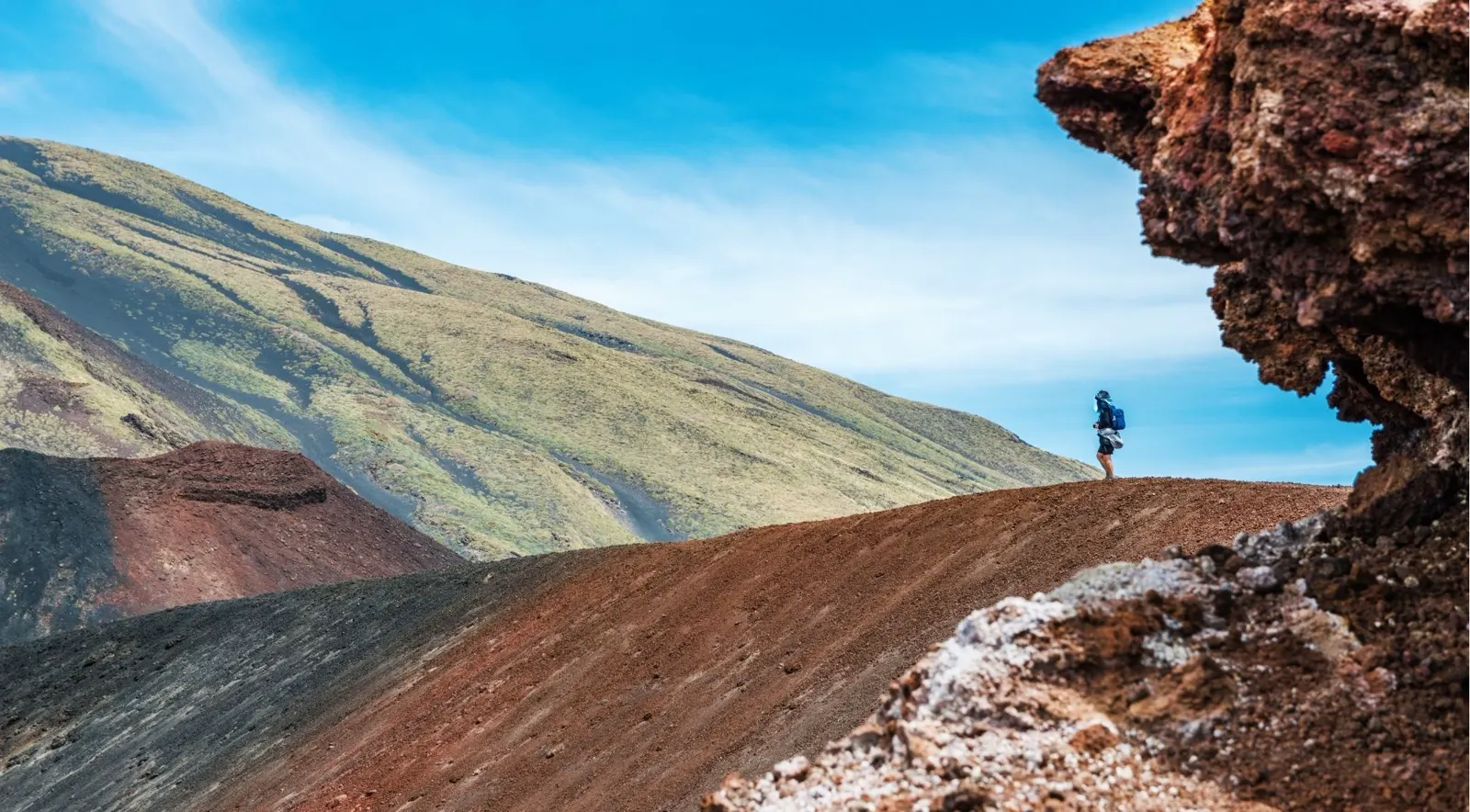
Picture standing at close to 3,000 m on Europe's most active volcano, snow under your boots, cloud below you and the Ionian coast beyond. That is a real winter day on Etna. A walk to the crater rim on any day you like is not, whatever some adverts suggest. How high you can go depends on three things: the volcano's alert phase, the mayor's ordinance and the snow. This guide explains all three, shows what you can do at each altitude, and points you to tours with licensed guides that run under the current rules.
The calendar above is for Mount Etna: Trek to 3000m with cable car and 4x4, run by the Etna South guides and rated 4.6/5 from more than 4,800 reviews on GetYourGuide, from $62 plus the cable car and vehicle fee paid on site. It is the trip most visitors take into the summit zone, and it works under preallarme when the weather allows. In snow the 4x4 leg becomes a snowcat, and if the upper road is shut the day ends at 2,500 m. Free cancellation runs to 24 hours before.
The three layers of rules that set how high you can go
- The Zona Sommitale (summit zone) starts at roughly 2,500 m on the south, west and north flanks, and it also takes in the upper Valle del Bove down to about 1,700 m. Inside it sits the Zona a Pericolosità Permanente (ZPP), the area around the summit craters.
- Sicily's Civil Protection (DRPC) declares an operational phase, attenzione, preallarme or allarme, based on ETNAS, INGV's early-warning system.
- Each town's mayor turns that phase into an ordinance: who can go where, how many people per guide, and how far from the active craters.
Winter adds a fourth layer that no ordinance spells out: snow, ice, wind and short days. These often stop tours lower than the legal limit.
For the latest eruption, airport and ash news, see Is Etna erupting now?. This page covers the rules and the altitudes.
How high you can go in winter, phase by phase
| Phase (DRPC) | What's closed | Alone (no guide) | With an authorized guide | Summit craters (3,300 m+) | Typical winter reality |
|---|---|---|---|---|---|
| Attenzione (lowest active phase) | Nothing closed outright; the ZPP is guide-only under the ordinances | Up to the summit-zone boundary (about 2,500 m on the south, west and north) | Into the ZPP on authorized routes, within the ordinance limits: 10 hikers per guide, daily caps and a minimum distance from the South-East Crater | Possible with a guide, though most operators sell it only from spring to autumn | Snow often stops tours around 2,800–3,000 m anyway |
| Preallarme (in force at our last check) | ZPP closed to everyone, guides included | Up to about 2,500 m | The summit zone outside the ZPP: in practice guided trips to about 2,800 m by snowcat or 4x4, or about 2,900–3,000 m on foot | No | Cable car plus snowcat, winter treks to about 3,000 m, snowshoeing at 1,800–2,200 m |
| Allarme | The whole summit zone closed, with checkpoints | Below about 2,500 m, and away from the upper Valle del Bove | The same as alone: below the summit zone | No | The cable car may run only to 2,500 m or stop; the north-side 4x4 track is suspended automatically |
How to read it: "alone" never means anywhere below 2,500 m whatever the weather. The DRPC warns that the summit zone can reach lower near active vents or lava flows, and in allarme the boundary is enforced at the gates.
The three phases explained, and why guide websites disagree
Attenzione. The summit area can be visited under the municipal ordinances. The ZPP is open only with guide alpine or guide vulcanologiche, on routes agreed with the guides' Collegio, in small groups that set off at intervals.
Preallarme. The ZPP is closed to everyone. In the DRPC's own wording, when this phase is restored the ZPP stays "interdetta" (closed), and mayors must suspend "tutte le attività escursionistiche che si svolgono nella Zona a Pericolosità Permanente" (all hiking activity in the Permanent Hazard Zone).
Allarme. The closure covers the whole Zona Sommitale, and anyone inside must leave at once by the safe routes. The Guardia di Finanza and the Regional Forestry Corps run checkpoints: on the north side along the track toward the observatory, and on the south side in the square in front of the cable car station.
ETNAS F0, F1 and F2: the confusing part
INGV's ETNAS early-warning system issues F0 (low probability of imminent lava fountains), F1 (high probability) or F2 (very high probability, or fountains under way).
- Many guide and news pages still show the standard mapping: F0 = attenzione, F1 = preallarme, F2 = allarme.
- In 2026 the floor was raised. The national alert went from green to yellow on 26 June 2026, and the DRPC made preallarme the baseline. Since then, F1 has triggered allarme (13 August and 12 October 2026), and a return to F0 has restored preallarme, not attenzione (DRPC notice n.11 of 20 August 2026; notice n.02 of 12 October 2026).
What that means for you: don't assume F0 means the craters are open. Check the phase in the latest DRPC notice.
How often does the phase change?
In 2026 it moved repeatedly:
- Preallarme from 26 June
- Allarme from 13 to 20 August, during lava fountains at the Voragine
- Airport disruption from ash on 26–28 September
- Allarme and back to preallarme on the same day, 12 October
The ordinances also say guides and transport operators must stop activities automatically when ETNAS changes, "senza attendere ordinanze" (without waiting for a new ordinance). Expect closures at short notice, even in the middle of a tour.
Other experiences you might enjoy around Etna this winter
Not every good Etna day goes above 2,500 m. Ride the Etna cable car from Rifugio Sapienza to the Montagnola, walk the Silvestri craters, go snowshoeing from Piano Provenzana, book an Etna sunset tour by 4x4 jeep with a lava cave, or taste Etna wine around Linguaglossa. Catania and Taormina are the usual bases.
What you can do at each altitude in winter
| Altitude | Named places | Access | Guide needed? | Typical winter options and prices |
|---|---|---|---|---|
| 1,800–2,000 m | Rifugio Sapienza and the cable car square (about 1,900 m, south); Piano Provenzana (about 1,800 m, north); the Silvestri craters | By car, with winter tires or chains on board from 15 November to 15 April, or by bus | No | Walks on the Silvestri craters (€5 entrance fee, which associations and the Comune di Nicolosi were challenging in court in October 2026), the ski area, and the starting point for every tour. See driving to Etna in winter |
| 2,000–2,500 m | The Montagnola and the cable car top station (2,500 m); the 2002 craters and lava woods on the north side, up to about 2,200 m | The Funivia dell'Etna (€54 return) or on foot; snowshoes in snow | No (below the summit zone), but a guide is strongly advisable in snow | Guided snowshoe hike from Piano Provenzana to about 2,200 m (Guide Vulcanologiche Etna Nord: €30 adults, €25 children; 3 h, about 300 m up and down). See snowshoeing on Etna |
| 2,500–2,900 m | The snowcat and 4x4 terminus (about 2,800 m by the operator's figure); the Barbagallo craters (2002–03 vents, about 2,800–2,900 m); Piano delle Concazze on the north side (2,800 m) | Snowcat in winter or a 4x4 bus from the cable car top; the north-side 4x4 track usually runs from spring to autumn | Yes, in practice. You are inside the summit zone | The cable car plus vehicle plus guide: the operator's Tour 3000 ticket is €82; resellers charge more. See Etna jeep and 4x4 tours |
| 2,900–3,000 m | The Torre del Filosofo area (about 2,900 m); the foot of the South-East Crater cone (about 3,000 m) | On foot from 2,500 m (about 500 m of climbing, about 5 h in all), or by vehicle plus a walk | Yes | A guided winter trek to about 3,000 m: about €50–60 for the guide plus the €54 cable car; crampons or snowshoes often required |
| 3,000 m+ (summit craters) | Bocca Nuova, the Voragine, the North-East Crater and the South-East Crater; the true summit is about 3,400 m (it varies) | 4x4 to about 2,850–2,920 m, then a 2-hour trek | Always, and only in attenzione | Summit treks (for example, on the north side about €69 for the guide plus €50 for the 4x4), mostly sold from April to October or November. Closed at our last check (preallarme) |
North vs south in winter
| Etna South (Nicolosi, Rifugio Sapienza) | Etna North (Linguaglossa, Piano Provenzana) | |
|---|---|---|
| Base altitude | About 1,900 m | About 1,800 m |
| Lifts in winter | The Funivia dell'Etna to 2,500 m, then a snowcat (or a 4x4 bus when there's no snow) to about 2,800 m | Ski lifts in season; the 4x4 track to Piano delle Concazze (2,800 m) depends on snow and is suspended automatically on F1 or F2 |
| Typical winter maximum | About 2,800 m by snowcat, or about 3,000 m on foot with a guide | About 2,200 m on snowshoes; higher only with ski-mountaineering guides when the volcano is calm |
| Ordinances that apply | Nicolosi (also Belpasso and Ragalna on the south flank) | Linguaglossa and Castiglione di Sicilia (also Randazzo on the north flank) |
| Best for | Getting high easily, the widest choice of bookable tours, first-timers | Quieter woods, snowshoeing, views toward Taormina, summit treks in summer |
| Skip if | You hate queues on sunny weekends | You need to reach 2,700 m or more in midwinter without ski skills |
Which towns issue ordinances for which flank:
- North: Linguaglossa, Castiglione di Sicilia, Randazzo
- East: Sant'Alfio, Piedimonte Etneo, Zafferana Etnea, and Milo, which issued its own ordinance in August 2026
- South: Nicolosi, Ragalna, Belpasso
- West: Adrano, Biancavilla, Bronte, Maletto
The Parco dell'Etna posts all of these ordinances on one page.
Our pick for winter: the south side, because the cable car and snowcat are the only reliable way for non-skiers to get above 2,500 m in snow. Choose the north side for a calmer snowshoe day; from the coast, see Etna tours from Taormina in winter.
What the ordinances say
- Nicolosi, ordinance n.13 of 11 September 2025 (south), for the ZPP during attenzione:
- guides only, at most 10 hikers per guide and 300 hikers a day
- groups start 15 minutes apart
- at least 300 m in a straight line from the base of the South-East Crater
- guides must put up warning signs and keep radio contact
- Linguaglossa, ordinance n.61 of 11 September 2025 (north), for the ZPP:
- guide alpine or vulcanologiche only, 10 per guide, 400 a day
- at least 500 m from the South-East Crater
- helmets supplied by the guide, and a signed fitness waiver for every participant
- the Piano Provenzana–Piano delle Concazze 4x4 track (1,800–2,800 m) stops automatically on F1 or F2
- Castiglione di Sicilia, ordinance n.17 of 10 September 2025. It also lists duties for hikers without a guide in the Zona Sommitale:
- walk only from dawn to dusk, with no bivouacs
- carry boots, a windproof jacket, a hat, food, water, a phone and a torch
- stay off the mountain if you have breathing or heart problems
- Belpasso, ordinance n.135 of 10 August 2026:
- 10 per guide, 15-minute intervals, 300 a day
- 300 m from the base of the South-East Crater
- 50 m from the edges of active lava flows
- a route agreed with the guides' Collegio, and a helmet for everyone at high altitude (the helmet rule as summarised by Sentieri Siciliani in September 2026)
- Bronte, 14 August 2026: suspended all ZPP excursions after the preallarme; anyone breaking it is referred to the judicial authority.
- An older rule still in circulation: a 2022 Nicolosi ordinance allowed free access to 2,500 m, guided access to 2,750 m and nothing above. Many blogs still quote it, but it is out of date.
Why you see 2,750 m, 2,920 m or 3,000 m quoted
Each of these figures was right at some point. The 2013 Prefecture framework allowed free hiking to the cable car top station (about 2,500 m) on the south and to Monte Pizzillo (about 2,450 m) on the north-east, with guides above that. Through the 2010s, ordinances capped guided groups at Torre del Filosofo (2,920 m) on the south and Punta Lucia (2,990 m) on the north. A 2019 Nicolosi ordinance set free access to 2,750 m and guided access from 2,750 to 2,920 m. Since the new perimeter of August 2025, the rules refer to the ZS and ZPP lines rather than to a height. When the trail-status site Sentieri Siciliani reviewed the latest Nicolosi, Belpasso and Castiglione di Sicilia ordinances on 16 September 2026, none set a fixed altitude cap. The line moves because the summit moves: craters grow and collapse, and the ZPP is drawn around wherever the hazard is.
Penalties: the ordinances cite article 650 of the Italian Penal Code (failing to obey an order of the authorities). That is a criminal offense: the article says offenders are punished "con l'arresto fino a tre mesi o con l'ammenda fino a euro 206" (arrest of up to three months or a fine of up to €206), on top of any rescue costs and insurance problems.
Who enforces it: the Guardia di Finanza and its mountain rescue unit, the Regional Forestry Corps, municipal police and Park staff patrol the slopes, and the CNSAS (the national alpine rescue corps) handles rescues. We found no fixed on-the-spot fine in the ordinances we checked, so treat any set "€X fine" quoted online with caution. The cases are real: in August 2026, MountainBlog reported, citing La Sicilia, that 21 hikers were identified and reported to prosecutors for entering the closed lava-flow area. We could not confirm whether Sicily charges for mountain rescue, so make sure your travel insurance covers mountain rescue and helicopter evacuation.
Do you need a guide for Etna?
- Below about 2,500 m, outside the summit zone: no.
- In the summit zone: in practice, yes.
- In the ZPP around the summit craters: always, and only when the phase allows.
Even in the lowest phase, the DRPC recommends visiting the summit zone "con l'accompagnamento di personale abilitato ai sensi di legge" (accompanied by staff qualified under the law).
Guide titles: who can take you where
| Title (Italian) | What it is | Can lead in the ZPP and summit craters? | Notes |
|---|---|---|---|
| Guida alpina – maestro di alpinismo | Full mountain guide (national law 6/1989) | Yes (named in the ordinances) | Required whenever the route needs ice axe, crampons or rope, which in winter is often the case |
| Aspirante guida alpina | Trainee mountain guide | Within the limits of the title | Listed in the same register |
| Guida vulcanologica | Volcano guide (Sicilian regional law 28/1996, on a special list kept by the Collegio) | Yes (named in the ordinances) | The core profession on Etna |
| Guida / accompagnatore di media montagna | Mid-mountain leader, in the Collegio register | No: the Collegio says they may not lead professionally on volcanoes | Fine for woods and snowshoe routes below the summit zone |
| GAE (guida escursionistica ambientale), tour leader or driver | Not a Collegio title; often only an association membership under law 4/2013 | No | Not authorized to lead on the volcano |
The Collegio Regionale delle Guide Alpine e Vulcanologiche della Sicilia is the public body that keeps the registers. It states that, under law 6/89 and regional law 28/1996, its four listed titles are the only professionals allowed to accompany people in mountain and volcanic terrain. It adds that on volcanoes this means guide alpine and guide vulcanologiche only: mid-mountain leaders are on its register but may not lead there, and neither may "hiking leaders" whose only credential is an association membership.
How to check a guide in two minutes
- Ask for the guide's full name and title.
- Find the name in the register on guidealpinevulcanologichesicilia.it, which lists Guide Alpine, Aspiranti, Guide Vulcanologiche and Guide di Media Montagna. Check the registration number and that the status reads "Regolare". If in doubt, call the Collegio office in Linguaglossa on +39 095 643750.
- On GetYourGuide, read the "Activity provider" line and check that the description says alpine or volcanological guide. Guide-run providers include:
- the Etna South guides behind Mount Etna: Trek to 3000m with cable car and 4x4, the most-booked trip into the summit zone
- Guide Vulcanologiche Etna Nord, who run the Piano Provenzana: Guided Mt. Etna Snowshoeing Trek
- Ashàra Etna & Stromboli Guides, who run the Etna South: High Altitude Winter Trek with an Alpine Guide and a 3,350 m summit trek
Red flags
- "We go to the craters whatever the alert": illegal in preallarme and allarme.
- No guide name or register number given.
- No helmet, no waiver, no group limit, or no crampons offered for a winter trip above the cable car.
- Pressure to go up on an allarme or preallarme day, or an offer to take you past a barrier.
- Groups far larger than 10 per guide in the summit zone.
- A "driver-guide" offering to walk you above the 4x4 terminus.
- Cash-only "summit" offers in the Rifugio Sapienza car park.
Our pick for fit hikers: the Etna South: High Altitude Winter Trek with an Alpine Guide by Ashàra Etna & Stromboli Guides, rated 4.8/5 from 27 reviews, so read the recent feedback. You meet at the Ashàra info point on the Rifugio Sapienza square, ride the cable car to 2,500 m and climb on foot to about 3,000 m with an alpine or volcanological guide in a very small group. Boots, a helmet, poles and the snow gear are supplied; the €54 cable car ticket is paid on the spot. It takes about 5 hours and is sold for experienced hikers aged 10 and over, so it is the wrong choice if you have never walked in snow.
Winter conditions above 2,000 m, and the gear to match
- Snow and ice: from roughly November to April the upper slopes are usually under snow. Hard snow above 2,700 m can turn a sandy summer path into crampon terrain. One GetYourGuide reviewer of the winter trek called the last stretch above 2,700 m "difficult, not medium".
- Wind and cold: the wind chill at 3,000 m can be far below what Catania suggests, and tours are cancelled for wind as well as for volcanic activity.
- Whiteout: cloud can wrap the summit zone in minutes, and the black lava and white snow lose all contrast.
- Short days: most winter departures leave around 08:30–09:00, and the ordinances limit hiking without a guide in the summit zone to the hours between dawn and dusk.
- Stay well away from lava on snow: it can cause steam explosions. On 16 March 2017, lava flowing onto snow caused a phreatic explosion that injured 10 people, including a BBC crew. Nicolosi's mayor, Nino Borzi, told Al Jazeera there were "around 35 people in the area close to the explosion" and that none of the injuries were serious; Euronews reported six people taken to hospital. The tourists were in a zone where guided access was allowed. The reported altitude was about 2,700 m (INGV via AP) or "around 2,900 meters… on a crater on the south-eastern side of the peak" (CNN).
- Rescues below the guide line: trouble on Etna is not limited to the summit zone. On 3 March 2026 a 28-year-old Belgian hiker in unsuitable shoes slid into a gully at the top of the Schiena dell'Asino ridge (about 2,500 m) and was rescued by the Soccorso Alpino. On 20 March 2026 two hikers lost their way back from the Monte Baracca area on the north side and were reached by snowmobile. On 13 October 2026 a 79-year-old Canadian visitor died of a cardiac event at the Silvestri craters. Cold and altitude add strain, and snow buries the trail markers.
- Avalanches and rescue: check the regional avalanche bulletin before ski touring or snowshoeing off-piste. Emergencies: 112. Sicilian Civil Protection hotline: 800 40 40 40.
| Gear | Below 2,200 m (snowshoes, woods) | 2,500–2,800 m (snowcat trip) | 2,800–3,000 m (winter trek) | Ski touring |
|---|---|---|---|---|
| Waterproof boots | Required | Required | Required (can be rented) | Ski boots |
| Snowshoes | Usually (about €12–15 to rent) | Rarely | Often (about €15) | – |
| Microspikes | Useful | Useful | The minimum | – |
| Crampons and ice axe | No | No | The guide decides (some operators include crampons) | Yes |
| Helmet | No | Supplied | Supplied and mandatory on many trips | Yes |
| Layers, gloves, hat, goggles | Yes | Yes | Yes | Yes |
More detail: what to wear on Etna in winter · skiing on Etna.
Ski touring: the rules attach to zones, not to activities, so the ZPP closure in preallarme applies to skiers too. Local guides say they reach 3,000 m on touring skis in heavy-snow winters "when the volcano is calm".
The best winter tours by maximum altitude
Ratings are from GetYourGuide (checked November 2026) and prices are the "from" figures we last saw in October 2026. Cable car and vehicle tickets are often paid separately, in cash. A private guide costs about €180–300 or more per group, plus the transport tickets. For a side-by-side look at operators, group sizes and what each price includes, see Etna winter tours compared.
| Tour (as named on GetYourGuide) | Provider | Highest point in winter | Price and reviews | Best for | Skip if |
|---|---|---|---|---|---|
| Piano Provenzana: Guided Mt. Etna Snowshoeing Trek | Guide Vulcanologiche Etna Nord | About 2,200 m | From about $44, snowshoes about €12 extra; 5.0/5 from only 4 reviews | Families and a first day in snow | You want the high-volcano feel |
| Mount Etna: Trek to 3000m with cable car and 4x4 | Etna South guides | 4x4 to about 2,800 m, then a walk to the Barbagallo craters (about 2,900 m); "3000m" is the marketing name | From $62 plus the cable car and 4x4 fee in cash; 4.6/5 from more than 4,800 reviews | Most visitors, and the most altitude for your money | Snow has closed the 4x4 road (it then becomes a snowcat trip or stops at 2,500 m) |
| Etna South: High Altitude Winter Trek with an Alpine Guide | Ashàra Etna & Stromboli Guides | About 2,870–3,000 m on foot | 4.8/5 from 27 reviews, plus the €54 cable car | Our pick for fit hikers: boots and crampons supplied, small groups | You've never hiked in snow, or you have children under 10 |
| Mount Etna 3000 m Summit Hike with Volcanology Guide | Etna Est | About 3,000 m | 4.8/5 from more than 1,400 reviews | Strong walkers who want pickup | You want vehicles to do the climbing |
| Mount Etna: Summit Crater Trek with Cable Car | A local guide office at Rifugio Sapienza | The summit craters only in attenzione; otherwise it falls back to the cable car area | From $73 plus €65 for the cable car and 4x4; 4.8/5 from more than 2,300 reviews | Summit attempts from spring to autumn | You're booking a fixed winter date |
| Etna: Guided Summit Hiking Tour up to 3400m, Optional Pickup | Sicilying, with C.R.G.A.V.S.-certified guides | A 3,000 m option (with the €54 cable car) or a 3,400 m option (€82 ticket) | From $62; 4.7/5 from more than 6,200 reviews | Flexibility: choose the 3,000 m option in winter | – |
| Mount Etna South: Summit Craters Tour in Cable Car & 4x4 Jeep and Etna: summit craters trekking with volcano guide 3350mt | Various | The crater rims, depending on the phase | From $68 (4.8/5 from 41 reviews) and from $74 (4.7/5 from more than 2,000 reviews) | Summer and autumn | You're booking for November to March |
Booking direct with the Funivia dell'Etna: the operator's Tour 3000 ticket costs €82 and covers the return cable car, the return 4x4 bus or, in winter, the snowcat, and an alpine or volcanological guide. Its page says the vehicles climb from 2,500 m to about 2,800 m; some resellers describe the winter version as stopping around 2,700 m with a guided walk to 2,750 m, and charge €95–100. The open ticket is valid from 08:30 to 15:15; the operator gives cable car hours of 08:30–16:45 with the last descent at 17:15, though partner sites report shorter hours in winter. For winter hours and the €54 return ticket to 2,500 m, read does the Etna cable car run in winter?
Health, altitude and children
- Altitude: 3,000 m is high enough for headaches, breathlessness and tiredness, especially after a fast cable car ride from sea level. Serious altitude sickness is uncommon on a half-day trip, but go slowly, drink water, and turn back if symptoms get worse.
- Volcanic gas: sulfur dioxide near the craters is an extra irritant. Every operator excludes people with heart or breathing problems, and pregnant women. Several also exclude people with high blood pressure, back problems or vertigo.
- Minimum ages on GetYourGuide listings:
- 6+ for the 3,000 m cable car and 4x4 trek
- 10+ for the winter high-altitude trek and Etna Est's 3,000 m hike
- 11+ or 12+ for most summit-crater treks, including Ashàra's 3,350 m trek and the north-side treks
Traveling with children? See Etna with kids in winter.
Myths vs facts
| Myth | Fact |
|---|---|
| "You can't go to the top of Etna in winter." | Partly true. You can reach about 2,800–3,000 m with guides in winter. The crater rims are rarely sold in winter, and at our last check they were closed under preallarme. |
| "Guides are optional if you're experienced." | Not in the ZPP: there it is guide alpine or vulcanologiche only, and only in attenzione. In allarme, nobody enters the summit zone. |
| "The Tour 3000 takes you to 3,000 m." | The vehicles stop around 2,800 m by the operator's figure (resellers quote anything from 2,700 to 2,920 m), and the guided walk adds a little. Some 2026 reseller listings describe the winter snowcat version as guided "fino a 2750 m". |
| "There's a fixed 2,500 m or 2,900 m rule." | The limit depends on the phase and the ordinance. 2,500 m is the indicative edge of the summit zone; the "2,900 m" figures come from older rules. |
| "F0 means everything's open." | In 2026, F0 has meant preallarme, with the craters closed. |
| "Etna is too gentle to be dangerous." | Sudden steam explosions killed 9 tourists at Bocca Nuova on 12 September 1979; the Smithsonian's Global Volcanism Program records that "a 30-second explosion from Bocca Nuova killed nine persons and injured 23", with some of the 150 tourists in the area standing on the crater rim. Another killed 2 people at the South-East Crater on 17 April 1987, about 500 m from the crater. Today's distance rules exist because of them. |
Check before you go
- Phase: open the latest Etna notice on the DRPC news page (the "Avviso regionale… eventi vulcanici Etna" items).
- Ordinance: check the Parco dell'Etna "Ordinanze Sindaci" page for your departure town (Nicolosi and Belpasso for the south, Linguaglossa for the north).
- Live status: Is Etna erupting now? and the INGV-OE weekly bulletin.
- Weather and wind at 3,000 m: the forecasts, plus the operator's morning confirmation (tours are "confirmed on the day").
- Is the cable car running? Check funiviaetna.com.
- Guide licence: the name is on the Collegio register.
- Kit: boots, layers, gloves, sunglasses, and snowshoes or crampons as advised.
- Car: winter tires or chains on board; see driving to Etna in winter, or, if you'd rather not drive, the bus and transfer options in Etna without a car in winter.
Month by month: November · December · January · February · March · the whole season: Mount Etna in winter.
Official sources
- DRPC Sicilia (Civil Protection), notices and phases: protezionecivilesicilia.it
- DRPC explainer on the volcanic notice: Avviso vulcanico
- National Civil Protection (alert levels): protezionecivile.gov.it
- Parco dell'Etna, mayors' ordinances: parcoetna.it
- INGV Osservatorio Etneo (bulletins): ct.ingv.it
- Collegio Regionale Guide Alpine e Vulcanologiche della Sicilia (guide register): guidealpinevulcanologichesicilia.it
- Funivia dell'Etna (cable car): funiviaetna.com
- Emergency: 112 · DRPC hotline 800 40 40 40
Notes on the figures: the 1987 explosion is dated 17 April by the Smithsonian GVP (one secondary source says 15 April). Crater heights move with eruptions: INGV-OE put the South-East Crater's northern rim at 3,357 m (±3 m) in August 2021, and its drone surveys measured the Voragine at 3,369 m in July 2024 and 3,403 m in September 2024. Tour ratings change daily.
Glossary
- Zona Sommitale (ZS): the summit zone: the summit craters, the upper Valle del Bove down to about 1,700 m, and the areas indicatively above 2,500 m on the south, west and north flanks.
- ZPP (Zona a Pericolosità Permanente): the permanent-hazard zone around the summit craters, inside the ZS. It replaced the old "zona gialla" (yellow zone) when the new perimeter came in in August 2025.
- Fase operativa locale: the regional operational phase (attenzione, preallarme, allarme).
- ETNAS: INGV's lava-fountain early-warning system (F0, F1, F2).
- DRPC: Dipartimento Regionale della Protezione Civile (Sicily).
- Ordinanza sindacale: a mayor's ordinance setting local access rules.
- Guida vulcanologica / guida alpina: licensed volcano guide / mountain guide.
- Gatto delle nevi: snowcat. Unimog: the 4x4 trucks above the cable car.
- Barbagallo craters / Torre del Filosofo: the 2002–03 vents and the former hut site at about 2,900 m on the south side.
- Piano delle Concazze / Pizzi Deneri: the north-side high plateau (2,800 m) and the observatory ridge.
- Phreatic explosion: a steam-driven blast when magma or lava meets water or snow.
FAQ: How High Can You Go on Etna in Winter?
Can you climb Etna in winter?
Yes, up to a point. On your own you can go to about 2,500 m. With an authorized guide you typically reach about 2,800 m by snowcat or about 3,000 m on foot. The summit craters need a guide, the attenzione phase and workable snow. At our last check on 19 November 2026 they were closed, because Etna was in preallarme.
How high can you go on Etna right now?
Under preallarme (DRPC notice n.02 of 12 October 2026, still the latest on 19 November 2026): alone to about 2,500 m, and with a guide into the summit zone outside the Permanent Hazard Zone. For today's status, see our Is Etna erupting now? page.
What is the Etna 2,500 m rule?
It is the indicative lower edge of the Zona Sommitale (summit zone) on the south, west and north flanks. Above it, municipal ordinances apply. Under allarme the whole zone is closed.
Can you hike Etna without a guide?
Yes, below the Zona Sommitale: the Silvestri craters, the Montagnola area, the 2002 craters and Monti Sartorius. Stay on marked paths and walk in daylight. In snow, a guide is the safer choice.
Do you need a guide for Etna's summit craters?
Always: a guida alpina or a guida vulcanologica, in groups of no more than 10 per guide, and only when the phase allows.
Does the Tour 3000 really reach 3,000 m?
Not by vehicle. The operator says its 4x4 buses (snowcats in winter) climb from 2,500 m to about 2,800 m, and a short walk with a volcanological guide goes higher when the authorities allow. Some resellers describe the winter version as stopping around 2,700 m with a guided walk to 2,750 m. Walking treks reach about 3,000 m.
Is there a winter tour to the summit craters?
Only in the attenzione phase and when the snow allows. Most operators sell the crater rims from April to October or November.
What happens if the phase changes during my tour?
Guides must stop and bring you out of the closed zone straight away. The ordinances require this automatically, without waiting for a new ordinance.
What is the penalty for entering a closed zone on Etna?
Referral to prosecutors under article 650 of the Italian Penal Code, which the municipal ordinances cite. The article provides for arrest of up to three months or a fine of up to 206 euros.
North or south side of Etna in winter?
South for altitude, because the cable car and snowcat run there. North for snowshoeing in quieter woods.
Are the rules different on the north side of Etna?
Partly. The alert phases apply to the whole volcano, but the ordinances come from different mayors. Linguaglossa sets a 500 m distance from the South-East Crater, against 300 m in Nicolosi and Belpasso, and a cap of 400 hikers a day. Routes start from Piano Provenzana.
How do I check that an Etna guide is licensed?
Ask for the guide's full name, then find it in the register on the Collegio's website and check that the status reads "Regolare". Only guide alpine and guide vulcanologiche may lead on the volcano. The Collegio office in Linguaglossa answers on +39 095 643750.
Where do I check Etna's status before I go?
The latest Etna notice on the DRPC Sicilia news page, the INGV-OE bulletins and the Parco dell'Etna "Ordinanze Sindaci" page. In an emergency call 112, or the regional Civil Protection line 800 40 40 40.
Is the Etna cable car open in winter?
Usually, yes, weather and the volcano permitting. It closes for high wind, ash or an allarme phase. Our cable car winter guide has the hours and tickets.
What is the minimum age for high-altitude tours on Etna?
Typically 6 to 12, depending on the tour. Most summit treks take children from 11 or 12.
Is altitude sickness a risk at 3,000 m on Etna?
Mild symptoms are possible. Operators exclude people with heart or lung conditions, and pregnant women.
What gear do I need for a winter trek to 3,000 m on Etna?
Waterproof boots, warm layers, gloves, a hat and sunglasses, plus snowshoes or crampons as the guide advises. Good operators supply a helmet and poles. The full kit list is in our guide to what to wear on Etna in winter.
How tall is Mount Etna?
About 3,350 to 3,400 m. The exact height changes with eruptions: INGV's drone surveys put the Voragine rim at 3,369 m in July 2024 and 3,403 m in September 2024.
Sources for this page: DRPC Sicilia notices and its Zona Sommitale and ZPP page, the municipal ordinances of Nicolosi, Linguaglossa, Castiglione di Sicilia, Belpasso and Bronte as posted by the Parco dell'Etna and the Etna guide associations, the Collegio Regionale Guide Alpine e Vulcanologiche della Sicilia, the Funivia dell'Etna's ticket pages, the Smithsonian Global Volcanism Program, INGV-OE, and reports by AP, CNN, Al Jazeera and Euronews on the 2017 explosion.
Final Word
In winter, about 2,500 m is as far as you go on your own, and about 2,800–3,000 m is the realistic ceiling with a guide while Etna stays in preallarme. The cable car and snowcat on the south side are the easy way up; a guided winter trek is the way to earn the last few hundred meters. Book with free cancellation, check the latest DRPC notice the evening before, and if you're driving up, read driving to Etna in winter next.