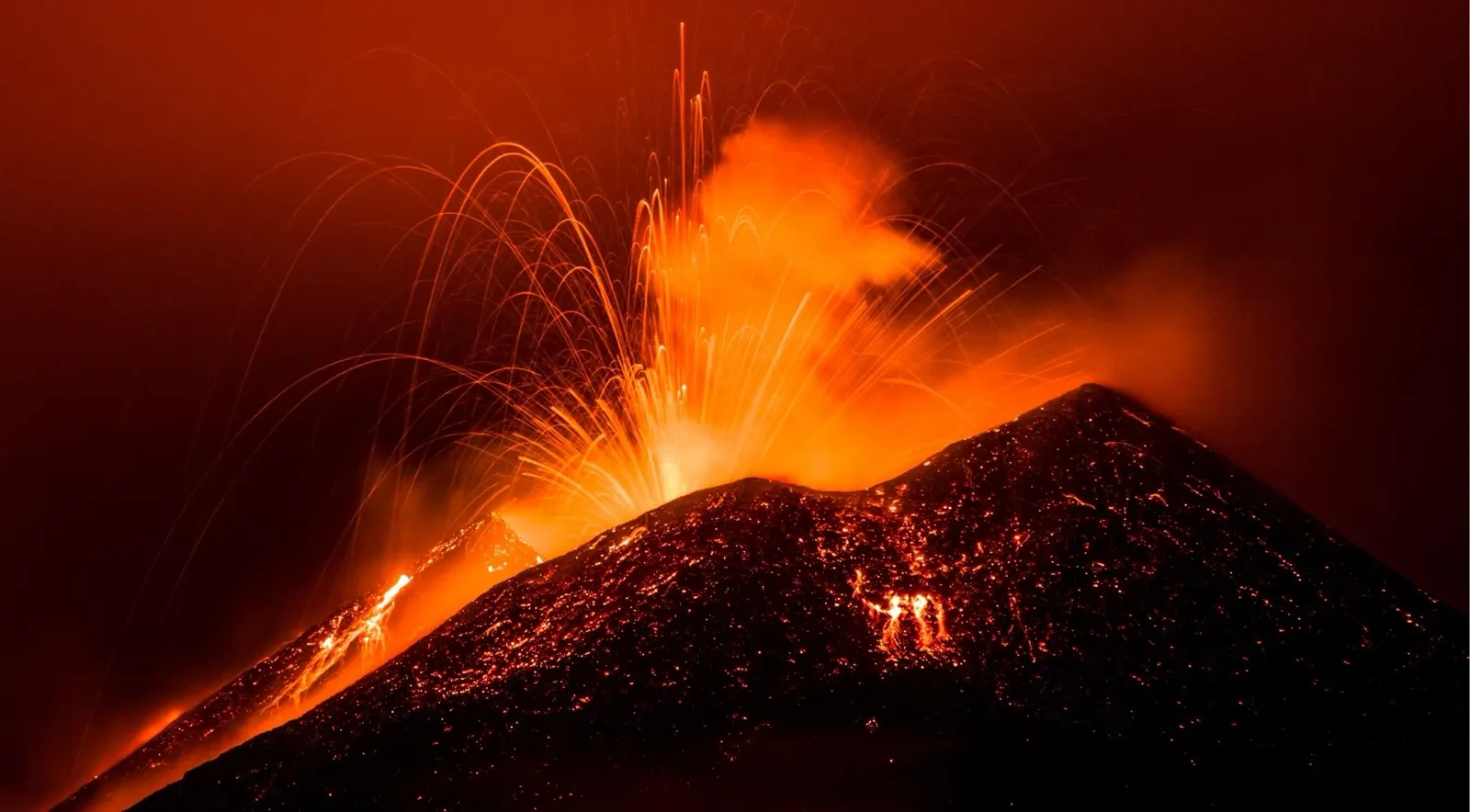
Etna is almost never fully asleep. In the 2025–26 season it sent a lava flow down the snowy Valle del Bove at New Year, threw lava fountains into the August sky and shut Catania airport more than once. In November 2026 it was in a quieter, restless phase. This page explains, in plain English, what the volcano was doing at our last check, what that means for your tour and your flight, and how to see lava safely when it returns.
The calendar above is the Catania: Etna Sunset Tour, Lava Cave by Jeep & Van (Etna & Sea Excursions), from $68, rated 4.7/5 from more than 2,700 reviews on GetYourGuide. It runs at about 2,000 m, well below the zones that close in an alert, takes 5–5.5 hours with at most 8 people, and offers free cancellation up to 24 hours before. If Etna does light up, a sunset tour is already on the mountain at dusk, when the glow shows best.
Last checked 19 November 2026. We review this page every Tuesday after INGV publishes its weekly bulletin, and whenever we see a change in the aviation code, a new regional notice, an airport closure or a felt earthquake of magnitude 3.5 or more. Between our checks, the official sources in How to check Etna's status yourself are always more current than we are.
Current Status (Last Checked 19 November 2026)
| Field | Status at our last check | What it means for you |
|---|---|---|
| Is Etna erupting? | No lava activity reported. Variable degassing and occasional ash emissions from the North-East Crater (INGV bulletin, 10 November) | No glowing lava to see; a summit plume is normal for Etna |
| Latest INGV weekly bulletin | Issued 10 November 2026: variable degassing, occasional ash from the North-East Crater, volcanic tremor at a medium level | Restless, but no lava fountains or flows reported |
| National alert level (Civil Protection) | Yellow since 26 June 2026; no change found on 19 November | Low-to-medium activity; summit access restricted |
| Regional phase (DRPC Sicilia) | Preallarme (ETNAS F0) since notice n.02 of 12 October 2026. Notice n.01, issued at 03:25 that day, had briefly raised it to allarme (F1). No Etna notice since, as of 19 November | The Permanent Hazard Zone (ZPP) around the summit craters is closed to everyone, guides included, so summit crater treks are suspended |
| Aviation color code (VONA) | Reported green since 11 November 2026 by a secondary source; we could not confirm it on INGV's VONA page. The last VONA we sourced directly was yellow (3 October) | Neither green nor yellow affects flights |
| Catania airport (CTA) | No ash closure in October or November 2026 (to 19 November); the last were on 26–29 September | Check aeroporto.catania.it and your airline on the day |
| Latest notable earthquake (at our 31 October check) | ML 3.8, 21 October 2026, 08:49, Valle del Bove (about 1 km east of the Monti Centenari, 7 km west of Milo), about 3.7 km deep; no damage reported | Felt widely; precautionary school evacuations; no access changes announced |
| Cable car (Funivia dell'Etna, south) | No 2026 maintenance closure announced; check on the day | The cable car to 2,500 m and Tour 3000 run subject to wind and the authorities' limits |
| North side (Piano Provenzana) | The Mareneve road from Linguaglossa was restored in early September 2026. The Mareneve stretch from Fornazzo towards Rifugio Citelli has been closed since a Città Metropolitana order of 8 January 2026, with no reopening found | North-side 4x4 trips run only outside the closed zone; reach Piano Provenzana from Linguaglossa, not from Fornazzo |
| Summit craters | Closed (ZPP) | No tours to the crater rims until the phase returns to attenzione |
Sources: INGV Osservatorio Etneo weekly bulletin of 10 November 2026; DRPC Sicilia notices index (read 19 November 2026); the Dipartimento della Protezione Civile for the national level; the green VONA from a secondary source only; airport closures as reported by ANSA; Città Metropolitana di Catania for the Mareneve order. The earthquake row dates from our 31 October check.
Quick Answer
Is Etna erupting right now? Not with lava, as of the latest INGV bulletin we could read. The bulletin of 10 November 2026 reported no lava fountains and no lava flows. Etna is in a restless, low-level phase:
- What's happening: gas emissions from the summit craters, occasional ash from the North-East Crater and medium-level tremor.
- Earthquakes: a felt ML 3.8 quake on 21 October under the Valle del Bove.
- Restrictions: the summit craters are closed as a precaution, but the rest of the mountain is open. You can still visit the 2002 craters, lava caves, the forests and the sunset viewpoints at about 1,900–2,000 m.
- Flights: we found no ash closure at Catania in October or November 2026.
INGV's own bulletin carries the honest caveat: on a volcano as often active as Etna, some phenomena can happen without warning or evolve quickly and unexpectedly, which means a hazard level "mai nullo", never zero. That is why this page gets a dated check every week.
Other experiences you might enjoy around Etna this winter
With the summit craters closed, the mountain below them is where the tours go. Book an Etna sunset tour by 4x4 jeep, walk inside a lava cave, look into the Valle del Bove from its rim, taste Etna wine around Linguaglossa or Milo, or ride the Etna cable car from Rifugio Sapienza. On the coast, Taormina and Catania are a short drive away.
How Etna's Warning System Works (and What Each Level Means for Your Trip)
Three separate systems run at once, and news headlines often mix them up. Here is how to read each one.
1. National alert level: Dipartimento della Protezione Civile
| Level | Meaning | Typical visitor impact |
|---|---|---|
| Green | Eruptive activity absent or very low | Normal access rules; guides required in the summit zone |
| Yellow | Low-to-medium activity; rapid change possible | Summit restrictions likely; tours adapt |
| Orange | Significant increase; an eruption of wider impact is possible | Large closures; follow local orders |
| Red | Major eruption with impact on wide areas | Emergency measures |
Etna has been at yellow since 26 June 2026. Civil Protection stresses that even at green, the risk on Etna "is never absent".
2. Regional operational phases: DRPC Sicilia (what opens or closes trails)
| Phase | What's closed | What you can do |
|---|---|---|
| Attenzione | Nothing closed outright; the ZPP is guide-only | Guided treks near the summit craters, with limits on group size and daily numbers |
| Preallarme | ZPP closed to everyone, guides included | The cable car, Tour 3000-type trips that stay outside the ZPP, the 2002 craters, lava caves, sunset tours |
| Allarme | The entire Zona Sommitale is closed (the craters, the upper Valle del Bove down to about 1,700 m, and roughly everything above 2,500 m on the south, west and north flanks), with checkpoints on Etna Sud and Etna Nord | Lower-altitude tours, caves, wineries, village viewpoints |
How the triggers worked in 2026: INGV's ETNAS early-warning system rates the probability of lava fountains as F0 (low), F1 (high) or F2 (very high, or fountains in progress). Since 26 June 2026 the regional floor has been preallarme. In practice, F1 and F2 notices have moved the phase up to allarme, and F0 notices have brought it back down to preallarme. On 12 October 2026, for example, the region issued an allarme notice in the early hours and stepped back to preallarme the same day. Some guide websites still publish an older mapping (F0 = attenzione, F1 = preallarme, F2 = allarme); always trust the dated DRPC notice.
Group limits under attenzione: municipal ordinances set the numbers. Belpasso's August 2026 ordinance allows at most 10 hikers per guide in the ZPP, with groups starting at 15-minute intervals. It caps entries at 300 people a day and requires hikers to stay at least 300 m from the base of the South-East Crater and 50 m from the edges of active lava flows. Linguaglossa's rules on the north side use the same 10-per-guide limit with a cap of 400 a day.
3. Aviation color code: INGV VONA
| VONA color | Meaning | What usually happens at Catania |
|---|---|---|
| Green | Volcano in a normal, non-eruptive state | Normal operations |
| Yellow | Elevated unrest / negligible ash | Normal operations |
| Orange | Eruption with minor ash, or an eruption is likely | Usually normal; some sectors may close depending on the wind |
| Red | Eruption with significant ash in the atmosphere | SAC may close airspace sectors, cap arrivals or suspend all flights |
A red VONA does not automatically close the airport. On 24 September 2026 INGV issued a red VONA for a 4 km ash cloud, yet flights at Catania stayed regular because the wind carried the ash away from the approach paths. The wind direction matters as much as the color.
Is It Safe to Visit Etna Right Now, and in Winter?
Yes, if you follow the current restrictions and choose your tour sensibly. Etna is one of the most closely monitored volcanoes on Earth, and access is managed day by day. Most incidents involve people who ignore closures or approach active vents. A long-term study of Etna's history counts only 77 deaths that can be put down to its eruptions with certainty in more than 2,000 years, and in the well-documented cases the victims were very close to active vents, or near lava meeting water or snow.
The real risks, in order of what affects most visitors
- Cold, wind and snow. In winter the 2,500–3,000 m zone can feel arctic, and wind regularly stops the cable car. This is the risk most likely to spoil your day. Weather can also kill: on 16 August 2026 a US visitor died after a lightning strike in the Rocca Capra area of the Valle del Bove, at about 1,400 m, and Italian media reported that he was inside a closed zone.
- Volcanic ash. Ash is gritty, irritates eyes and lungs, makes roads slippery and closes the airport. At village level it is mostly a nuisance.
- Ballistic "bombs". During paroxysms, blocks of rock fall around the summit craters, which is why the ZPP and the Zona Sommitale close. Sudden blasts have caught tourists before: on 12 September 1979 an explosion at the Bocca Nuova killed nine, and on 17 April 1987 one at the South-East Crater killed two people and injured seven standing about 500 m away. Those events are why the summit is regulated today.
- Lava meeting snow. On 16 March 2017, lava flowing over snow at about 2,900 m caused a steam-driven (phreatic) explosion that hurt a BBC film crew and tourists. Nicolosi's mayor, Nino Borzi, quoted by Al Jazeera, said: "There were 10 injuries... But none serious", and that about 35 people were near the blast. Never get close to an active flow, however slow it looks.
- Volcanic gas. SO₂ and CO₂ collect in hollows near the craters. This matters for anyone with asthma or a heart condition.
- Earthquakes. Etna's flanks see frequent shallow quakes. The ML 3.9 of 15 August 2026 cracked the Mareneve road near Piano Provenzana, and the 21 October 2026 quake prompted school evacuations. Neither injured anyone.
If ash falls where you're staying
Ash on Catania or the east-coast towns is a nuisance, not a danger. The International Volcanic Health Hazard Network (IVHHN) gives simple advice:
- Wear a well-fitting FFP2 or N95 mask outdoors while ash is in the air or being swept.
- Swap contact lenses for glasses, because ash grit can scratch the eye. Goggles help in fine ash.
- Stay indoors when you can and keep the windows shut.
- Keep children inside. Adult masks don't fit them well.
- Bring the washing in, and don't swim in a pool with ash on it until it has been cleaned.
- Dampen ash lightly before sweeping it. Towns usually want it bagged apart from household waste.
Driving in ash: ash on tarmac is as slippery as fine sand on ice, and passing cars throw it up into your view. After the ashfall of 16–17 August 2026, Acireale set a 30 km/h limit on all its roads and neighbouring Aci Catena banned two-wheelers. Drive slowly with a long gap, rinse the windscreen before using the wipers (dry ash scratches the glass), and leave the scooter parked.
Why a guided tour matters here
- Legally: above the Zona Sommitale limit (about 2,500 m), municipal ordinances require an authorized alpine or volcanological guide. Our guide to altitude limits by alert phase has the details.
- Practically: guides get phase changes in real time and turn groups around immediately. They know which zones are open that day, and on the north side they bring the 4x4 access you can't get on your own.
- Our advice: for anything above the cable car's top station, book a guide. For the lava caves, forests and sunset viewpoints, a small-group jeep tour such as the Etna Sunset Tour, Lava Cave by Jeep & Van is the best value.
What happens to your tour if the phase changes?
- Operators reroute (for example to lower craters, caves or the Valle del Bove rim) or cancel.
- Many GetYourGuide Etna tours offer free cancellation up to 24 hours before the start. Check each listing, because terms vary.
- If the operator cancels because of a closure, you should be offered a refund or a new date.
- Before you pay, look for a stated plan B route if the summit is closed, and for authorized volcanological or alpine guides.
- Cable car tickets work differently. The Funivia dell'Etna's terms of sale say tickets for a set date carry no right of withdrawal under the Italian Consumer Code, so you can't cancel just because you changed your mind. The cable car also stops for wind, storms and volcanic restrictions; if the operator suspends service, check the refund terms on your ticket confirmation.
- Our tip: book your Etna day early in your trip, so you have spare days to reschedule.
To see how each operator's winter route and plan B compare, read our Etna winter tours compared guide.
Can You See Lava on Etna?
Not at our last check: the 10 November 2026 bulletin reported no lava. When Etna does erupt, though, it's one of the few places in Europe where you can watch lava fountains from a café terrace.
How often does Etna put on a show?
Often, but not on a schedule.
- 2021: INGV's 10 August 2021 press release counted "circa 50 episodi parossistici" (about 50 paroxysms) at the South-East Crater from 16 February 2021. A 2023 study in the Bulletin of Volcanology timed the 17 fountains of 16 February to 1 April 2021 at between 0.8 and 10.5 hours each, 2.9 hours on average, so a single show rarely outlasts an evening.
- Summer 2024: the Voragine produced lava fountains in July.
- The 2025–26 season: Strombolian activity, lava fountains and a lava flow in the Valle del Bove (24 December 2025 to 13 January 2026); fountains and flank vents from late June to August 2026; ash-only episodes in September 2026.
- What to expect: a few active windows a year, each lasting days to weeks. Some phases stay hidden inside the summit craters, and in winter cloud can hide even big events.
Where to watch safely when Etna is active
| Viewpoint | Best for | Notes |
|---|---|---|
| Zafferana Etnea / Milo / Fornazzo | Valle del Bove flows, summit fountains | East-flank villages; Milo's belvedere faces the Valle del Bove |
| Sant'Alfio / Linguaglossa | North-East Crater and north-east views | Linguaglossa is also the gateway to Piano Provenzana |
| Schiena dell'Asino (south rim of the Valle del Bove) | Close views of flows in the Valle del Bove | Road access from the Zafferana / Rifugio Sapienza area; may be inside the closure zone during allarme |
| Pietracannone trail (when open) | Flows on the Valle del Bove floor | Gated during the January 2026 eruption; check its status |
| The coast: Riposto, Giarre, Taormina, Catania | Fountains and glow at night from 25–30 km | Zero risk, and great for photographers with a long lens |
Night viewing: fountains and lava glow are far more dramatic after dark. Sunset tours are the natural fit, because they already finish at dusk, and when activity is visible several operators adjust their routes to reach legal viewpoints. Expect rules on timing: during the 2026 Valle del Bove flows, Milo, Sant'Alfio and Zafferana allowed excursions only until dusk, in groups of up to 10 with authorized guides. Compare them in our Etna sunset tours guide.
Photography tips:
- Use a tripod and a 70–300 mm lens.
- Start at ISO 800–1600 with 2–10 second exposures for the glow.
- Expect cloud on the east flank in winter.
- Check INGV's thermal webcams before setting out.
Never walk toward an active lava flow or cross a barrier. In August 2026, crowds gathered at the edges of the closed zone to watch the eruption despite warnings from local guides, and the region then closed the entire summit area. That month 21 hikers were reported to the judicial authorities for walking up to the lava front inside a closed zone, and Milo banned anyone from coming within 200 m of the front.
Catania Airport and Etna Ash: How Closures Work
- INGV issues the VONA.
- Air traffic services model where the ash cloud is heading.
- SAC, the airport operator, announces the measure: closing specific airspace sectors (named B1, B2, B3, C1 and so on), capping arrivals (for example "max 5 aircraft per hour"), or suspending all flights for a set number of hours.
- SAC's standard advice is the same every time: check your flight status with your airline before going to the airport.
How long do closures last? Usually hours, sometimes a few days. Summer 2026 was exceptional.
Recent airport disruption (2026)
| Date | What happened | Scale |
|---|---|---|
| 13 Jan 2026 | Winter eruption declared over; VONA back to green | The airport was fully operational through most of the lava-flow phase |
| 5–6 Jul 2026 | New fissure toward the North-East Crater and a paroxysm; total shutdown | 188 flights cancelled, 60 diverted and 7 rescheduled (La Sicilia's count); 33 diverted to Palermo; Civil Protection handed out water in the terminal |
| 7–15 Aug 2026 | The most energetic phase: Voragine lava fountains and flank vents in the Valle del Bove; intermittent full closures | SAC's 13 August note (via Il Fatto Quotidiano): "circa 630 voli" diverted over 6–12 August and about 36% of roughly 1,974 scheduled flights cancelled; SAC called it the "crisi più severa degli ultimi vent'anni", the most severe crisis in 20 years (CataniaToday); Comiso "ha riprotetto 140 voli", took 140 flights (Sky TG24, 14 August), and itself closed and reopened; Catania reopened at 14:00 on 15 August |
| 17 Aug 2026 | Arrivals capped at 5 an hour until 14:00 (sectors B1 and B2 closed); departures unaffected | Partial |
| 14 Sep 2026 | Sectors C1 and B3 closed; arrivals and departures suspended until 22:00 | Most of a day |
| 24 Sep 2026 | Red VONA (4 km ash cloud) | The airport stayed open, because the wind blew the ash away from it |
| 26–28 Sep 2026 | North-East Crater ash; all flights suspended from Saturday morning; reopened on the evening of 28 September when the VONA dropped to orange (ANSA) | About 3 days |
| 29 Sep 2026 | VONA back to red; flights suspended "until 15:00" | ANSA reports the stop lasted just over half an hour |
| 3 Oct 2026 | VONA yellow: negligible ash | Normal operations at our last check |
August figures differ slightly by outlet: 1,974 or about 1,900 scheduled flights, and 684 cancelled according to SAC's president.
Why a closure matters so much: on Assaeroporti's 2025 figures, Catania was Italy's fifth-busiest airport, with 12,363,135 passengers. Its January–September 2026 traffic fell 3.4% after the Etna closures, which dropped it to sixth. L'Espresso reported that the airport handles "almeno quarantamila passeggeri al giorno" (at least 40,000 passengers a day) in peak season. A closure ripples through the whole of eastern Sicily: car-hire and taxi prices jumped in August 2026. Il Sole 24 Ore's English edition (12 August 2026) reported that "according to the official fares, the Trinacria taxi company in Palermo charges 500 euros" for the trip to Catania airport, and some travelers were asked for up to €700.
Alternative airports if Catania closes
| Airport | Approx. distance to Catania by road | Notes |
|---|---|---|
| Comiso (CIY) | About 1.5–2 h | The closest, but small, and it can also close when ash drifts south-west |
| Palermo (PMO) | About 2.5–3 h | The main diversion airport; few direct transfers to Catania |
| Trapani (TPS) | About 3.5–4 h | Took diversions in July and August 2026; buses were scarce |
| Reggio Calabria (REG) + Strait ferry | About 2–3 h including the ferry | Useful for Taormina and Messina |
During the August 2026 crisis the regional government said more than a hundred buses and special trains were laid on to move diverted passengers.
Winter traveler checklist
- Put your Etna tour early in your trip, not the day before you fly.
- Leave a buffer day before any connecting long-haul flight.
- Turn on airline app notifications and check aeroporto.catania.it.
- Check the VONA color and the wind forecast the evening before.
- Buy travel insurance that explicitly covers natural disasters and volcanic ash disruption. Many policies limit cover once an event is "known", so buy early.
- Book flexible fares, or fares with free date changes when the extra cost is small.
- Pick car hire with free cancellation and a flexible drop-off. If you land in Palermo instead, you may want to collect a car there.
- Keep every receipt for meals, hotels and transport (your rights are below).
- Have a plan B that doesn't need the summit: Etna wine tasting, Catania's baroque centre and fish market, Taormina, or a day in Siracusa and Ortigia.
Flight Cancelled Because of Etna Ash? Your Rights (EU261)
| Question | Answer |
|---|---|
| Do I get cash compensation (€250–600)? | No. Volcanic ash is an "extraordinary circumstance", which exempts airlines from fixed compensation |
| Do I get my money back or a new flight? | Yes. You choose: a full refund, or re-routing at the earliest opportunity or at a later date of your choice |
| Must the airline look after me while I wait? | Yes. Meals, refreshments, hotel accommodation and transfers |
| Is there a limit on that care? | No. In McDonagh v Ryanair (C-12/11, 31 January 2013), the EU Court of Justice ruled that care has no temporal or monetary limit, even for volcanic closures. Ryanair had argued that the Eyjafjallajökull ash cloud was "super extraordinary"; the Court disagreed |
| The airline didn't help, so I paid myself. Now what? | Claim reimbursement of costs that were "necessary, appropriate and reasonable", with receipts |
| What about package holidays? | Your organizer has its own duties under package-travel rules; contact them first |
Our advice: if you're stranded, ask the airline desk for meal vouchers and a hotel before booking anything yourself. If they can't help, keep your spending reasonable and keep every receipt.
Winter Eruptions: Lava on Snow
Winter activity is spectacular to watch and tricky to plan around. In January 2026 a lava flow ran down the snowy Valle del Bove, and in February 2021 paroxysms began a historic series. What changes in winter:
- Snow hides terrain and lava edges. Contact between lava and snow or ice can trigger steam explosions, as in 2017. The first dusting of the 2026–27 season reached Rifugio Sapienza on 2 November 2026.
- Short days: in December the sun sets well before 17:00, which leaves less time to fit in a rescheduled tour.
- Roads: the SP92 (south) and the Mareneve (north-east) can need chains or close for snow and ash. Winter tires or chains are compulsory on Etna's provincial roads from 15 November to 15 April; chains, closures and parking are in driving to Etna in winter.
- Access: Tour 3000 uses snowcats instead of 4x4 buses in winter. See does the Etna cable car run in winter?
- Visibility: the east flank often sits in cloud, so a glowing summit can be invisible from Zafferana yet clear from Catania.
Month-by-month advice: November · December · January · February · March · the whole season: Mount Etna in winter.
2025–26 Eruption Timeline
| Date | Event |
|---|---|
| 24 Dec 2025 | Eruption begins: Strombolian activity at the summit craters |
| 27 Dec 2025 | Paroxysms at the North-East Crater |
| 1 Jan 2026 | A fissure opens at about 2,100 m just above Monte Simone, at the base of the Valle del Bove's north wall; lava effusion about 5 m³/s |
| 2 Jan 2026 | The flow is about 2.8 km long, its front at about 1,420 m east of Rocca Musarra; INGV says it will stay inside the uninhabited Valle del Bove |
| 13 Jan 2026 | INGV declares the phase over; VONA green |
| 26 Jun 2026 | National alert green → yellow; regional preallarme; ZPP closed. Effusive activity near the Valle del Leone / upper Valle del Bove at about 3,000 m |
| 5 Jul 2026 | New fissure toward the North-East Crater plus a Voragine paroxysm; the first airport closure of the summer |
| 30–31 Jul 2026 | A lava flow from about 2,700 m in the Valle del Leone reaches 1,700–1,750 m; ash column to about 7,000 m |
| 6 Aug 2026 | Voragine Strombolian activity becomes lava fountaining; multiple flows in the Valle del Bove |
| 7–15 Aug 2026 | Repeated fountains; flank vents at about 1,900 m (flow front to about 1,330 m) and a new vent at about 3,100 m; ash column about 6,000 m; the airport shut intermittently |
| 13 Aug 2026 | Regional allarme: the entire Zona Sommitale closed |
| 15 Aug 2026 | An ML 3.9 quake about 7 km west of Linguaglossa reactivates the Pernicana fault; the Mareneve road cracks; restaurants at Piano Provenzana are evacuated |
| 16–22 Aug 2026 | The phase switches several times between allarme and preallarme (DRPC notices n.7 to n.13, 17–22 August) |
| 26 Aug 2026 | INGV declares the eruptive event over; VONA green |
| Early Sep 2026 | The Mareneve road from Linguaglossa to Piano Provenzana is restored |
| 24 Sep 2026 | Red-brown ash plume from the North-East Crater to 4 km; INGV links it to old material being blown out of the conduit, not to fresh explosive activity; VONA red |
| 26–29 Sep 2026 | Airport closures (see above) |
| 3 Oct 2026 | VONA yellow: "negligible ash emission ongoing" |
| 12 Oct 2026 | Night-time tremor spike to high values and strong North-East Crater degassing; a brief allarme (DRPC notice n.01), then preallarme (n.02) the same day |
| 18 Oct 2026 | ML 3.3 on the west flank (Monte Minardo) |
| 21 Oct 2026 | ML 3.8 under the Valle del Bove, about 7 km west of Milo; schools evacuated as a precaution; no damage |
| 19–25 Oct 2026 | INGV's weekly bulletin: variable degassing, occasional ash from the North-East Crater, tremor mostly medium, thermal activity low |
| 10 Nov 2026 | INGV's weekly bulletin: variable degassing, occasional ash from the North-East Crater, tremor at a medium level; still no new DRPC notice since 12 October |
Etna's Famous Eruptions (for Context)
| Year | What happened | Why it matters |
|---|---|---|
| 1669 | The largest historical flank eruption; lava reached Catania and the sea | The benchmark worst case |
| 1928 | Lava destroyed the town of Mascali | The last time a town was wiped out |
| 1971 | An eruption destroyed the old observatory and cable car | Why today's tourist infrastructure sits where it does |
| 1983 | The first attempt to divert lava with explosives | The beginning of active lava management |
| 1991–93 | The longest eruption of the 20th century; Zafferana was threatened and saved by diversion works | Explains Zafferana's lava-front landmarks |
| 2001, 2002–03 | Twin flank eruptions; 2002 destroyed the Piano Provenzana tourist facilities | The "2002 craters" visited on tours today |
| 2008–09 | A long effusive eruption into the Valle del Bove | A classic "safe" eruption for viewers |
| 2011–13 | Dozens of paroxysms building the New South-East Crater | Etna's modern "fountain era" |
| 2013 | Etna inscribed as a UNESCO World Heritage Site | — |
| Dec 2018 | A flank eruption plus the M4.9 Fleri earthquake on 26 December | Showed that quakes, not lava, are the main threat to flank villages |
| 2021 | About 50 paroxysms at the South-East Crater from 16 February (INGV, 10 August 2021) | Pushed the summit to a record 3,357 m (±3 m), measured from Pléiades satellite images of 13 and 25 July 2021 |
| Jul–Aug 2024 | Voragine paroxysms; INGV drone surveys put the rim at 3,369 m in July and 3,403 m on 12 September 2024; airport closures | The highest elevations measured on Etna |
| 2025–26 | See the timeline above | — |
How high is Etna? Its height changes with every eruption. Recent official figures range from 3,350 m (Civil Protection's volcano sheet) and 3,357 m (Smithsonian GVP) to 3,369 m and 3,403 m (INGV's 2024 drone surveys of the Voragine rim). We say "about 3,350–3,400 m"; the 2026 eruptions may have changed it again, and no newer survey figure had been published when we checked.
How to Check Etna's Status Yourself (Official Sources)
| Source | What you get | Where |
|---|---|---|
| INGV Osservatorio Etneo: weekly bulletin | The authoritative weekly summary (issued on Tuesdays) | ct.ingv.it → Bollettini settimanali |
| INGV communications | Real-time "comunicati" when activity changes | ct.ingv.it → Comunicati vulcanici |
| INGV VONA | The aviation color code | The VONA section of ct.ingv.it |
| INGVvulcani blog | Scientists' explainers (for example, on the September 2026 red plume) | ingvvulcani.com |
| Volc@Hazard | Satellite thermal data | ct.ingv.it/technolab/volchazard |
| DRPC Sicilia notices (avvisi ETNA) | The regional phase that opens or closes trails | protezionecivilesicilia.it |
| DRPC Telegram | Push alerts | t.me/DRPCSiciliaNews |
| National Civil Protection | The alert level (green / yellow / orange / red) | rischi.protezionecivile.gov.it |
| SAC, Catania airport | Closures, sectors, flight status | aeroporto.catania.it |
| INGV earthquakes | Quake list and maps | terremoti.ingv.it |
| Smithsonian GVP | A weekly summary in English | volcano.si.edu |
| Unofficial dashboards | etnaradar.it (refreshes every 10 minutes: tremor, NASA heat, quakes, VONA), etnamonitor.it, VolcanoDiscovery | Handy, but always confirm with INGV or the DRPC |
| Webcams | INGV visible and thermal cams; private cams at Rifugio Sapienza, the cable car and Piano Provenzana; SkylineWebcams | Check the thermal cams at night for glow |
Which Tour Should You Book? Picks for Each Alert Phase
| Situation | Best choice | Our pick on GetYourGuide |
|---|---|---|
| Quiet volcano / preallarme (as at our last check) | A sunset jeep tour with a lava cave | The Catania: Etna Sunset Tour, Lava Cave by Jeep & Van (Etna & Sea Excursions, 4.7/5 from more than 2,700 reviews, from $68, 5–5.5 h, max 8, free cancellation 24 h) |
| The best-rated sunset by 4x4 | A small group, with sunset at about 2,000 m | The Catania: Mount Etna Sunset Tour with 4x4 Vehicles (4.8/5 from more than 850 reviews, from $68) |
| The north side by 4x4 | A 4x4 from Piano Provenzana to the upper craters, then a short trek | The Mount Etna: North Upper Craters Guided Tour by 4x4 with Trek (4.6/5 from 500 reviews, from $91, about 2.5 h). A daytime trip, and it runs only outside the closed zones |
| Altitude by day | Cable car + 4x4 or snowcat + guide | The Mount Etna: Trek to 3000m with cable car and 4x4 (4.6/5 from more than 4,800 reviews, from $62; the cable car and 4x4 fee is paid on site) |
| The volcano plus wine | A hike to the craters, a lava cave, then wine and lunch | The From Taormina: Full-Day Etna, Wine & Alcantara Canyons Tour (4.8/5 from more than 500 reviews, from about $153, a full day of about 8.5 hours with hotel pickup); more in our Etna wine tours guide |
| Staying in Taormina | A sunset tour with pickup in Taormina | The Taormina: Mount Etna Sunset Tour with Cave Visit and Tasting (4.7/5 from 494 reviews, from $88, 5 h); see also Etna tours from Taormina in winter |
| Plan B (allarme, bad weather) | Lava caves, forests and a winery | See our 4x4 and lava cave guide |
| Etna erupting visibly | An evening tour to legal viewpoints | The sunset tours above; ask the operator whether they adapt the route to viewing points |
| Cruise passengers | A tour with a fixed, guaranteed return time | Pick a route that doesn't depend on summit access; see Etna shore excursions in winter and Etna tours from Catania |
Prices are as shown on GetYourGuide in October 2026 (USD display) and change with currency and season. More options in our sunset tours and 4x4 and jeep tours guides.
What Each Kind of Etna Activity Means for You
| Activity | What it means for you | Typical closures |
|---|---|---|
| Degassing (the normal plume) | Nothing, apart from good photos | None beyond the standing summit rules |
| Strombolian activity | A night glow you can see from the towns | The ZPP may close (preallarme) |
| Lava fountain / paroxysm | A show from afar, with ash risk | The Zona Sommitale closes (allarme); airport sectors may close |
| Lava flows in the Valle del Bove | Viewable only with authorized guides, when allowed | Valle del Bove trails, the Mareneve towards Citelli, minimum distances from the front |
| Ash emissions | The biggest impact on travel | Catania airport limits or closure (hours to about 3 days); ash speed limits in towns |
| Flank eruption or volcanic earthquakes | Rare, and more serious locally | Roads on the affected flank; wider ordinances |
Glossary
- Paroxysm: a short, violent eruptive episode (hours), usually with lava fountains and a tall ash column.
- Lava fountain: a jet of molten lava hundreds of meters high, driven by gas.
- Strombolian activity: rhythmic explosions throwing glowing scoria a few tens to hundreds of meters.
- Effusive eruption: lava flows out with little explosivity, often from flank vents (for example, in the Valle del Bove).
- Phreatic explosion: a steam-driven blast when hot rock or lava meets water, snow or ice.
- Volcanic tremor: continuous ground vibration linked to magma movement; INGV rates it low, medium or high.
- VONA: Volcano Observatory Notice for Aviation, issued by INGV, with green, yellow, orange and red codes.
- ZPP (Zona a Pericolosità Permanente): the permanently hazardous area around the summit craters.
- Zona Sommitale (ZS): the wider summit zone: the craters, the upper Valle del Bove down to about 1,700 m, and roughly everything above 2,500 m on the south, west and north flanks.
- ETNAS: INGV's early-warning system for lava fountains (F0 / F1 / F2).
- INGV-OE: Istituto Nazionale di Geofisica e Vulcanologia, Osservatorio Etneo (Catania).
- DRPC: Dipartimento Regionale della Protezione Civile (Sicily).
- Summit craters: the Voragine, Bocca Nuova, the North-East Crater and the South-East Crater.
FAQ: Is Etna Erupting Now?
Is Etna erupting today?
Not with lava, as of the latest INGV weekly bulletin we could read (issued 10 November 2026). It reported variable degassing, occasional ash from the North-East Crater and volcanic tremor at a medium level, with no lava fountains or flows. Check INGV's communications for anything newer.
Is it safe to visit Mount Etna now?
Yes, within the current limits. The summit craters are closed under preallarme, but the cable car, the 2002-crater walks, lava caves and sunset tours can run, weather permitting. Above about 2,500 m, go with an authorized guide.
What is Etna's current alert level?
The national level has been yellow since 26 June 2026, with no change found. The regional phase is preallarme: notice n.02 of 12 October 2026 was still the latest Etna notice on the regional Civil Protection site when we checked on 19 November 2026. One secondary source reported the aviation code (VONA) as green from 11 November; we could not confirm it with INGV.
Can you see lava on Etna right now?
Not as of the latest bulletin we could read (10 November 2026). When activity resumes, the best safe viewpoints are Milo, Zafferana, Fornazzo, Sant'Alfio and the coast from Riposto to Taormina, ideally at night.
Is Catania airport closed because of Etna?
We found no ash closure in October or November 2026 when we checked on 19 November; the last were on 26–29 September. Check aeroporto.catania.it and your airline on the day you fly.
How long do Etna ash closures at Catania last?
Usually a few hours. In bad phases they can run for days: August 2026 brought intermittent closures over more than a week, and September 2026 brought about three days.
Will I get EU261 compensation if Etna cancels my flight?
No cash compensation, because volcanic ash is an extraordinary circumstance. You are entitled to a refund or re-routing, plus meals and a hotel, with no time or cost cap (CJEU McDonagh v Ryanair, 2013).
Which airports can I use if Catania closes?
Comiso (about 1.5–2 h by road), Palermo (about 2.5–3 h), Trapani, or Reggio Calabria with the Strait ferry.
Does Etna erupt in winter?
Yes. Etna's activity has no seasons: the 2025–26 eruption ran from Christmas Eve to mid-January, and the 2021 paroxysm series began in February. Lava on snow is spectacular but adds steam-explosion risk.
How often does Etna erupt?
Some activity, from degassing to ash puffs and Strombolian explosions, happens in most months. Bigger episodes came again and again in 2025–26: late December 2025 into January 2026, then July, August and September 2026. Nobody can predict whether one will fall on your two or three days in the area.
Do I need a guide to visit Etna?
Not for the cable car, the Silvestri craters or forest trails. Yes for the Zona Sommitale above about 2,500 m, where municipal ordinances require authorized guides.
What happens to my tour if the alert level goes up?
Operators reroute to open areas or cancel. Most GetYourGuide Etna tours allow free cancellation up to 24 hours before; operator cancellations should be refunded or rebooked.
Was there an earthquake on Etna recently?
Yes. An ML 3.8 (some outlets reported 3.9) struck under the Valle del Bove at 08:49 on 21 October 2026. It was felt widely, with no damage reported. Quakes like this are common on Etna and don't, by themselves, mean an eruption is imminent.
How high is Mount Etna?
About 3,350–3,400 m, and the figure changes with eruptions. INGV's drone surveys measured the Voragine rim at 3,369 m in July 2024 and 3,403 m in September 2024.
Where can I watch an Etna webcam live?
Use INGV's visible and thermal cameras, plus private cams at Rifugio Sapienza, the cable car and Piano Provenzana. Dashboards such as etnaradar.it combine webcams with tremor and satellite data.
Does travel insurance cover volcanic ash?
Many policies do, but not all. Some exclude events that were already in the news when you bought the policy, so buy early and look for volcanic eruption or volcanic ash in the wording.
Is Taormina affected by Etna eruptions?
Rarely, and lightly. It can get some ashfall when the wind carries ash north-east, and it shares any flight disruption at Catania. Otherwise it is one of the best places to watch the volcano.
Where can I check Etna's current status?
INGV's Etna Observatory (ct.ingv.it) for bulletins and real-time notices, DRPC Sicilia (protezionecivilesicilia.it) for the regional phase, the national Civil Protection (rischi.protezionecivile.gov.it) for the alert level, aeroporto.catania.it for flights, and your tour operator for what runs that day.
Should I cancel my Sicily trip because of Etna?
Almost never. Even in August 2026, life on the coast continued normally. Protect yourself with a buffer day before flights, flexible bookings and travel insurance that covers ash disruption.
Sources for this check: INGV Osservatorio Etneo weekly bulletins (most recently the one issued 10 November 2026), the DRPC Sicilia notices index, the Città Metropolitana di Catania, the Funivia dell'Etna terms of sale, IVHHN ashfall guidance, the Bulletin of Volcanology (2023), the Dipartimento della Protezione Civile, SAC Catania airport notices as reported by ANSA, Il Fatto Quotidiano, Sky TG24, CataniaToday, La Sicilia and L'Espresso, Assaeroporti, the Smithsonian Global Volcanism Program and the EU Court of Justice judgment C-12/11.
Final Word
At our last check Etna was restless rather than erupting: degassing, the odd puff of ash from the North-East Crater, and the summit craters closed under preallarme. That still leaves the cable car, the 2,900–3,000 m tours when the weather allows, lava caves, wineries and the sunset viewpoints. Put your Etna day early in the trip, book with free cancellation, and read the INGV bulletin and the latest DRPC notice the week you go. If the cable car is your plan, read does the Etna cable car run in winter? next.